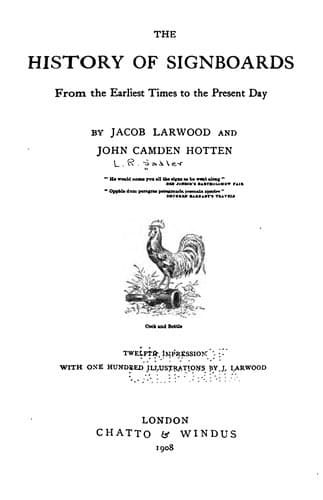
The History of Signboards, from the Earliest times to the Present DayHotten, John Camden
History
The History of Signboards, from the Earliest times to the Present Day
Hotten, John Camden
Inn signs -- England -- History; Signs and signboards -- History
His prophecies were also translated into Italian, and printed at Venice
in 1516. The annotators say it was reported that Merlin, by his
enchantments, transported from Ireland those huge stones found in
Salisbury plain. His cave was in Clerkenwell, on the site where the
alehouse now stands, and was in the reign of James I., one of the London
sights strangers went to see.[97]
We have a well-known chapbook hero in JACK OF NEWBURY, who had already
attained to the signboard honours in the seventeenth century, when we
find him on the token of John Wheeler, in Soper Lane (now Queen Street,
Cheapside,) whilst at present, he may be seen in a full-length portrait
in Chiswell Street, Finsbury Square. This Jack of Newbury, alias
Winchcombe, alias Smallwoode, “was the most considerable clothier
England ever had. He kept an hundred looms in his house, each managed by
a man and a boy. He feasted King Henry VIII. and his first Queen
Catherine at his own house in Newbury, now divided into sixteen
clothiers’ houses. He built the Church of Newbury, from the pulpit
westward to the town.”[98] At the battle of Flodden in 1513, he joined
the Earl of Surrey with a corps of one hundred men, well equipped at his
sole expense, who distinguished themselves greatly in that fight. He is
buried in Newbury, where his brass effigy is still to be seen,
purporting that he died February 15, 1519. An inn bearing his sign in
Newbury, is said to be built on the site of the house where he
entertained King Harry. Thomas Deloney, the ballad-writer, wrote a tale
about him, entitled, “The pleasant history of John Winchcomb, in his
younger years called Jack of Newberry, the famous and worthy clothier of
England, declaring his life and love, together with his charitable deeds
and great hospitalitie. Entered in the Stationers’ Book, May 7, 1596.”
Public-domain text, read in full here on John Shaqi.
Reviews
Reviews
No reviews yet
Be the first to share your thoughts on this work.
Elsewhere in the archive
Join the Discussion
Join the discussion
Sign in to leave a comment or review.
Sign InorCreate an account