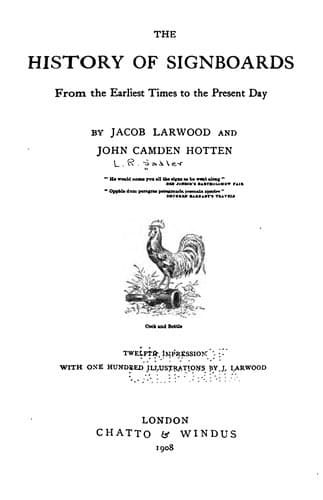
The History of Signboards, from the Earliest times to the Present DayHotten, John Camden
History
The History of Signboards, from the Earliest times to the Present Day
Hotten, John Camden
Inn signs -- England -- History; Signs and signboards -- History
WHITTINGTON AND HIS CAT is still very common, not only in London but in
the country also. Sometimes the cat is represented without her master,
as on the token of a shop in Longacre, 1657, and on the sign of ----
Varney, a seal-engraver in New Court, Old Bailey, 1783, whose
shopbill[99] represents a large cat carved in wood holding an eye-glass
by a chain. The story of Whittington is still a favourite chapbook tale,
and has its parallel in the fairy tales of various other countries.
Straparola, in his “Piacevole Notte,” is, we believe, the first who
mentions it. The earliest English narrative occurs in Johnson’s “Crown
Garland of Golden Roses,” 1612, but there is an allusion to “Whittington
and his Puss” in the play of “Eastward Hoe!” 1603. For more than a
century it was one of the stock pieces of Punch and his dramatic troop.
Sept. 21, 1688, Pepys went to see it: “To Southwark Fair, very dirty,
and there saw the puppet-show of Whittington, which is pretty to see;
and how that idle thing do work upon people that see it, and even myself
too.” Foote, in his comedy of the “Nabob,” makes Sir Matthew Mite
account for the legend by explaining the cat as the name of some
quick-sailing vessels by which Whittington imported coals, which should
have been the source of the Lord Mayor’s wealth. In the Highgate Road
there is a skeleton of a cat in a public-house window, which by the
people who visit there is firmly believed to be the earthly remains of
Whittington’s identical cat. The house is not far distant from the spot
where the future Lord Mayor of London stopped to listen to the city
bells inviting him to return. It is now marked by a stone, with the
event duly inscribed thereon.
King Arthur’s ROUND TABLE is to be seen on various public-houses. There
is one in St Martin’s Court, Leicester Square, where the American
champion, Heenan, put up when he came to contest the belt with the
valiant Tom Sayers. The same sign is also often to be met with on the
Continent. In the seventeenth century there was a famous tavern called
_la Table Roland_ in the Vallée de Misère at Paris. JOHN-O’-GROAT’S
HOUSE is also used for a sign; there was one some years ago in Windmill
Street, Haymarket; and at present there is a JOHN-O’-GROAT’S in Gray
Street, Blackfriars Road. Both these and the Round Table contain, we
conceive, some intimation of that even-handed justice observed at the
houses, where all comers are treated alike, and one man is as good as
another.
DARBY AND JOHN, a corruption of Darby and Joan, and borrowed from an old
nursery fable, is a sign at Crowle, in Lincolnshire; and HOB IN THE
WELL, with a similar origin, at Little Port Street, Lynn; whilst SIR
JOHN BARLEYCORN is the hero of a ballad allegorical of the art of
brewing, &c.
Public-domain text, read in full here on John Shaqi.
Reviews
Reviews
No reviews yet
Be the first to share your thoughts on this work.
Elsewhere in the archive
Join the Discussion
Join the discussion
Sign in to leave a comment or review.
Sign InorCreate an account