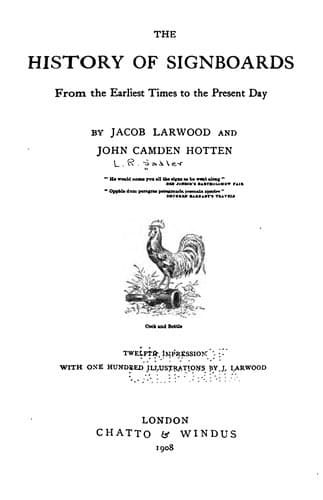
The History of Signboards, from the Earliest times to the Present DayHotten, John Camden
History
The History of Signboards, from the Earliest times to the Present Day
Hotten, John Camden
Inn signs -- England -- History; Signs and signboards -- History
A favourite ballad of our ancestors originated the sign of the LONDON
APPRENTICE, of which there are still numerous examples. How they were
represented appears from the _Spectator_, No. 428, viz., “with a lion’s
heart in each hand.” The ballad informs us that the apprentice came off
with flying colours, after endless adventures, one of which was that
like Richard Cœur-de-Lion--he “robbed the lion of his heart.” The ballad
is entitled “The Honour of an Apprentice of London, wherein he declared
his matchless manhood and brave adventures done by him in Turkey, and by
what means he married the king’s daughter of that same country.”
The ESSEX SERPENT is a sign in King Street, Covent Garden, and in
Charles Street, Westminster, perhaps in allusion to a fabulous monster
recorded in a catalogue of wonders and awful prognostications contained
in a broadside of 1704,[100] from which we learn that, “Before Henry the
Second died, a dragon of marvellous bigness was discovered at St Osyph,
in Essex.” Had we any evidence that it is an old sign, we might almost
be inclined to consider it as dating from the civil war, and hung up
with reference to Essex, the Parliamentary general; for though we have
searched the chroniclers fondest of relating wonders and monstrous
apparitions, we have not succeeded in finding any authority for the St
Osyph Dragon, other than the above-mentioned broadside.
Literature of a somewhat higher class than street ballads, has likewise
contributed material to the signboards. One of the oldest instances is
the LUCRECE, the chaste _felo-de-se_ of Roman history, who, in the
sixteenth century, was much in fashion among the poets, and was even
sung by Shakespeare. We find that “Thomas Berthelet, prynter unto the
kynges mooste noble grace, dwellynge at the sygne of the Lucrece, in
Fletestrete, in the year of our Lorde 1536.” In 1557, it was the sign of
Leonard Axtell, in St Paul’s Churchyard; and in the reign of Charles I.,
of Thomas Purfoot, in New Rents, Newgate Market, both booksellers and
printers. The COMPLETE ANGLER was _the_ usual sign of fish-tackle
sellers in the last century, and the essays of the _Spectator_ made the
character of SIR ROGER DE COVERLEY very popular with tobacconists.
DOCTOR SYNTAX hangs at the door of many public-houses, as at Preston,
Oldham, Newcastle, Gateshead, &c.; the LADY OF THE LAKE at Lowestoft;
DANDIE DINMONT at West Linton, Carlisle; PICKWICK in Newcastle; the RED
ROVER, Barton Street, Gloucester;[101] TAM O’ SHANTER, Laurence Street,
York, and various other towns; ROBIN ADAIR, Benwell, Newcastle. Popular
songs also belong to this class, as the LASS O’ GOWRIE, Sunderland and
Durham; AULD LANG SYNE, Preston Street, Liverpool; TULLOCH-GORUM and
LOCH-NA-GAR, both in Manchester; ROB ROY, Titheburn Street, Liverpool;
FLOWERS OF THE FOREST, Blackfriars Road. On the whole, however, this
class of names is much more prevalent in the northerly than in the
southerly districts of England.
Public-domain text, read in full here on John Shaqi.
Reviews
Reviews
No reviews yet
Be the first to share your thoughts on this work.
Elsewhere in the archive
Join the Discussion
Join the discussion
Sign in to leave a comment or review.
Sign InorCreate an account