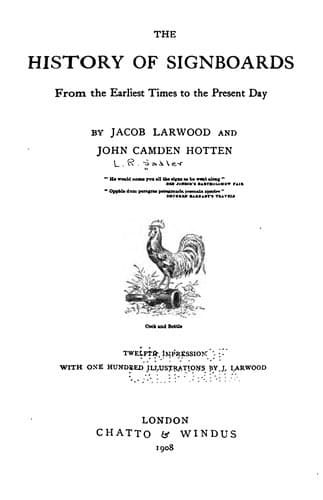
The History of Signboards, from the Earliest times to the Present DayHotten, John Camden
History
The History of Signboards, from the Earliest times to the Present Day
Hotten, John Camden
Inn signs -- England -- History; Signs and signboards -- History
In the south, if we except THE OLD
ENGLISH GENTLEMAN, who occurs everywhere, the great JIM CROW is almost
the only instance of the hero of a song promoted to the signboard.
ROBINSON CRUSOE is common to all the seaports of the kingdom, whilst
UNCLE TOM, or UNCLE TOM’S CABIN, is to be found everywhere, not only in
England, but also on the Continent. Any little underground place of
refreshment or beer-house difficult of access, is considered as
fittingly named by Mrs Beecher Stowe’s novel.
A very appropriate, and not uncommon public-house sign is the TOBY
PHILPOTT. That he well deserves this honour, appears from the following
obituary notice, (in the _Gent. Mag._, Dec. 1810:)--
“At the Ewes farm-house, Yorkshire, aged 76, Mr Paul Parnell, farmer,
grazier, and maltster, who, during his lifetime, drank out of one
silver pint cup upwards of £2000 sterling worth of Yorkshire Stingo,
being remarkably attached to Stingo tipple of the home-brewed best
quality. The calculation is taken at 2d. per cupful. He was the
_bon-vivant_ whom O’Keefe celebrated in more than one of his
Bacchanalian songs under the appellation of Toby Philpott.”
Between St Albans and Harpenden, there was, some years ago, and perhaps
there is still, a public-house called the OLD ROSON. This name also
appears to be borrowed from the well-known song, “_Old Rosin_ the Beau,”
beginning thus:--
“I have travell’d this wide world over,
And now to another I’ll go,
I know that good quarters are waiting
To welcome old Rosin the Beau (ter.)
When I am dead and laid out on the counter,
A voice you will hear from below,
Singing out brandy and water
To drink to old Rosin the Beau (ter.)
You must get some dozen good fellows,
And stand them all round in a row,
And drink out of half-gallon bottles,
To the name of old Rosin the Beau,” &c.
These stanzas, and one or two more to the same import, were quite
sufficient to make the old Beau a fit subject for the signboard,
irrespective of his other amiable qualities held forth in the song. The
very common OLD HOUSE AT HOME, too, is borrowed from a once-popular
ballad, the verse of which is too well known to need quotation here.
The equally common HEARTY GOOD FELLOW is adopted from a Seven Dials
ballad:--
“I am a hearty good fellow,
I live at my ease,
I work when I am willing,
I play when I please.
* * * * *
With my bottle and my glass,
Many hours I pass,
Sometimes with a friend,
And sometimes with a lass,” &c.
Public-domain text, read in full here on John Shaqi.
Reviews
Reviews
No reviews yet
Be the first to share your thoughts on this work.
Elsewhere in the archive
Join the Discussion
Join the discussion
Sign in to leave a comment or review.
Sign InorCreate an account