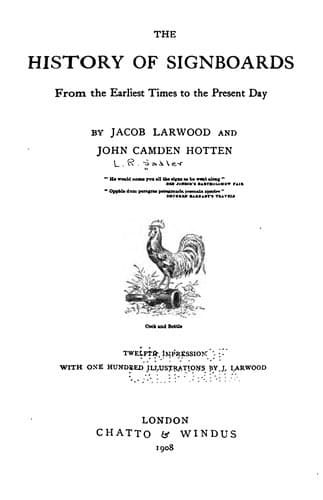
The History of Signboards, from the Earliest times to the Present DayHotten, John Camden
History
The History of Signboards, from the Earliest times to the Present Day
Hotten, John Camden
Inn signs -- England -- History; Signs and signboards -- History
Of signboards portraying artists, but few instances occur; and when they
do, they are almost exclusively the property of printsellers. We have
only met with three: REMBRANDT’S HEAD, the sign of J. Jackson,
printseller, at the corner of Chancery Lane, Fleet Street, 1759; and of
Nathaniel Smith, the father (?) of J. T. Smith, in Great May’s
Buildings, St Martin’s Lane. Another member of that family, J. Smith,
who kept a printshop in Cheapside, where several of Hogarth’s engravings
were published, assumed the HOGARTH’S HEAD for his sign. The third is
the VAN DYKE’S HEAD, the sign of C. Philips, engraver and
print-publisher in Portugal Street, in 1761. Hogarth also had a head of
Van Dyke as his trade symbol, made from small pieces of cork, but being
gilt, he called it the GOLDEN HEAD, (_see under_ Miscellaneous Signs.)
In old times, more than at present, music was deemed a necessary adjunct
to tavern hospitality and public-house entertainment. The fiddlers and
ballad singers of the “tap” room, however, gave way to the newer brass
band at the doors, and this, in its turn, is now gradually fading before
the “music hall” and so-called “concert” arrangement. Singing, it may be
remarked, is one of the first follies into which a man falls after a too
free indulgence in the cup. It is not to be wondered at, therefore, that
musical signboards should have swung from time to time over the alehouse
door. PAGANINI, who contributed so much to the popularity of that
well-known part of the “Carnival de Venise”--still the shibboleth of all
fiddlers--is of very common occurrence.
The love for music is also eloquently expressed by the sign of the
FIDDLER’S ARMS, Gornal Wood, Staffordshire. JENNY LIND seems to be the
only musician of modern times who has found her way to the signboard. In
the last century, HANDEL’S HEAD was common; but at the present moment,
no instance of its use remains. The MAID AND THE MAGPIE, a very common
tavern title, is believed to be the only sign borrowed from an opera. In
Queen Anne’s time, there was a PURCELL’S HEAD in Wych Street, Drury
Lane, the sign of a music-house. It represented that musician in a
brown, full-bottomed wig, and green nightgown, and was very well
painted. Purcell, who died in 1682, greatly improved English melody; he
composed sonatas, anthems, and the music to various plays. His “Te Deum”
and “Jubilate” are still admired.
Actors, and favourite characters from plays, have frequently been
adopted as signs. The oldest instance we find is TARLETON, or DICK
TARLETON, who, in the sixteenth century, seems to have been common
enough to make Bishop Hall allude to him in his “Satyres,” (b. vi., s.
1)--
“O honour far beyond a brazen shrine,
To sit with Tarlton on an ale-post’s sign.”
Public-domain text, read in full here on John Shaqi.
Reviews
Reviews
No reviews yet
Be the first to share your thoughts on this work.
Elsewhere in the archive
Join the Discussion
Join the discussion
Sign in to leave a comment or review.
Sign InorCreate an account