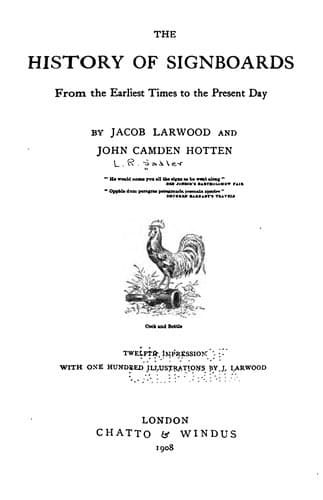
The History of Signboards, from the Earliest times to the Present DayHotten, John Camden
History
The History of Signboards, from the Earliest times to the Present Day
Hotten, John Camden
Inn signs -- England -- History; Signs and signboards -- History
Tarleton is seen on the trades token of a house in Wheeler Street,
Southwark; and it is only within a very few years that this sign has
been consigned to oblivion. Richard, or “Dick” Tarleton was a celebrated
low-comedy actor, born at Condover in Shropshire, and brought to town in
the household of the Earl of Leicester. He first kept an ordinary in
Paternoster Row, called the CASTLE, much frequented by the booksellers
and printers of St Paul’s Churchyard. Afterwards, he kept the TABOR, in
Gracechurch Street. He was one of Queen Elizabeth’s twelve players, in
receipt of wages, and was at that time living as one of the grooms of
the chamber at Barn Elms, but lost his situation by reason of some
scurrilous reflections on Leicester and Raleigh. He probably also
performed at the Curtain in Shoreditch, in which parish he was buried,
September 3, 1588. “The great popularity which Tarlton possessed may be
readily seen from the numerous allusions to him in almost all the
writers of the time, and few actors have been honoured with so many
practical tokens of esteem. His portrait graced the ale-house,
game-cocks were named after him, and a century after his death, his
effigy adorned the jakes.”[102] The portrait of this famous wit is
prefixed to the edition of his jests, printed in 1611, where he is
represented in the costume of a clown playing on the tabor and pipe.
Another portrait of him occurs as an accompaniment to the letter T, in a
collection of ornamental letters,[103] with the following rhymes:--
“This picture here set down within his letter T,
Aright doth shew the forme and shape of Tharleton unto thee.
When he in pleasaunt wise the counterfeit expreste,
Of clowne with cote of russet hew, and startups w^{th} the reste;
Who merry many made when he appear’d in sight,
The grave, the wise, as well as rude, att him did take delight.
The partie now is gone, and closlie clad in claye;
Of all the jesters in the lande, he bare the praise awaie.
Now hath he plaied his parte, and sure he is of this,
If he in Christe did die to live with Him in lasting bliss.”
SPILLER’S HEAD was the sign of an inn in Clare Market, where one of the
most famous tavern clubs was held. This meeting of artists, wits,
humorists, and actors originated with the performances at Lincoln’s Inn,
about the year 1697. They counted many men of note amongst their
members. Colley Cibber was one of the founders, and their best
president, not even excepting Tom d’Urfey. James Spiller, it should be
stated, was a celebrated actor _circa_ 1700. His greatest character was
“Mat o’ the Mint,” in the Beggar’s Opera. He was an immense favourite
with the butchers of Clare Market, one of whom was so charmed with his
performances, that he took down his sign of the BULL AND BUTCHER, and
put up SPILLER’S HEAD. At Spiller’s death, (Feb. 7, 1729,) the following
elegiac verse was made by one of the butchers in that locality:--
Public-domain text, read in full here on John Shaqi.
Reviews
Reviews
No reviews yet
Be the first to share your thoughts on this work.
Elsewhere in the archive
Join the Discussion
Join the discussion
Sign in to leave a comment or review.
Sign InorCreate an account