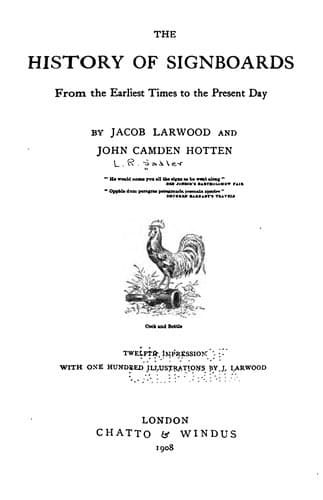
The History of Signboards, from the Earliest times to the Present DayHotten, John Camden
History
The History of Signboards, from the Earliest times to the Present Day
Hotten, John Camden
Inn signs -- England -- History; Signs and signboards -- History
“Down with your marrow-bones and cleavers all,
And on your marrow-bones ye butchers fall!
For prayers from you who never pray’d before,
Perhaps poor Jimmie may to life restore.
‘What have we done?’ the wretched bailiffs cry,
‘That th’ only man by whom we lived should die!’
Enraged they gnaw their wax and tear their writs,
While butchers’ wives fall in hysteric fits;
For, sure as they’re alive, poor Spiller’s dead.
But, thanks to _Jack Legar!_ we’ve got his _head_.
He was an inoffensive, merry fellow,
When sober, hipp’d, blythe as a bird when mellow.”
A ticket for one of his benefit representations, engraved by Hogarth, is
still a _morceau recherché_ amongst print collectors, as much as £12
having been paid for one. “Spiller’s Life and Jests” is the title of a
little book published at that time.
GARRICK’S HEAD was set up as a sign in his lifetime, and in 1768 it hung
at the door of W. Griffiths, a bookseller of Catherine Street, Strand.
It is still common in the neighbourhood of theatres. There is one in
Leman Street, Whitechapel, not far from the place of his first
successes, where, in 1742, he played at the theatre in Goodman’s Fields,
and “the town ran horn-mad after him,” so that there were “a dozen dukes
of a night at Goodman’s Fields sometimes.”[104]
ROXELLANA was, in the seventeenth century, the sign of Thomas Lacy, of
Cateaton Street, (now Gresham Street,) City. It was the name of the
principal female character in “The Siege of Rhodes,” and was originally
the favourite part of the handsome Elizabeth Davenport, whose sham
marriage to the Earl of Oxford, (who deceived her by disguising a
trumpeter of his troop as a priest,) is told in De Grammont’s Memoirs.
After she had found out the Earl’s deception, she continued under his
protection, and is occasionally mentioned, (always under the name of
Roxellana,) with a few words of encomium on her good looks by that
entertaining gossip, Pepys.
Formerly there was a sign of JOEY GRIMALDI at a public-house nearly
opposite Sadler’s Wells Theatre; not only had it the name, but _addidit
vultum verbis_, in the shape of a clown with a goose under his arm, and
a string of sausages issuing from his pocket. Joey’s name being less
familiar to the public of the present day, the house is now called the
CLOWN. This, we think, is the last instance of an actor being elevated
to signboard honours.
ABEL DRUGGER is one of the _dramatis personæ_ in Ben Jonson’s comedy of
the Alchymist, and from the character given him by his friend Captain
Face, we get some curious information concerning the mysteries of the
tobacco trade of that day:--
Public-domain text, read in full here on John Shaqi.
Reviews
Reviews
No reviews yet
Be the first to share your thoughts on this work.
Elsewhere in the archive
Join the Discussion
Join the discussion
Sign in to leave a comment or review.
Sign InorCreate an account