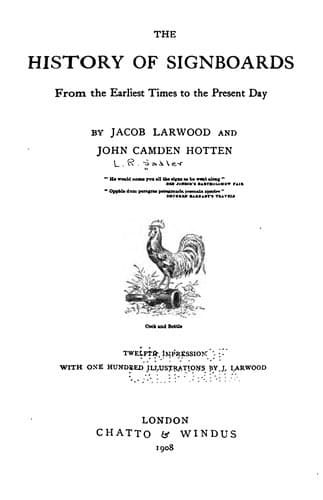
The History of Signboards, from the Earliest times to the Present DayHotten, John Camden
History
The History of Signboards, from the Earliest times to the Present Day
Hotten, John Camden
Inn signs -- England -- History; Signs and signboards -- History
From his connexion with the great Sir Hans Sloane, and the tradition of
a descent from the Tradescants, Salter was of course in duty bound to
have a museum of curiosities, which, by gifts from Sir Hans and certain
aristocratic customers in the army and navy, soon became sufficiently
interesting to constitute one of the London sights. It existed more than
a century, and was at last sold by auction in the summer of 1798. From
his catalogue[114] (headed with the words, “O RARE!”) we gather that the
curiosities fully deserved that name, for amongst them we find: “a piece
of St Catherine’s skin;” “a painted ribbon from Jerusalem, with which
our Saviour was tied to the pillar when scourged, with a motto;”[115]
“a very curious young mermaid-fish;” “manna from Canaan, it drops from
the clouds twice a year, in May and June, one day in each month;” “a
piece of nun’s skin;” “a necklace made of Job’s tears;” “the skeleton
(sic) of a man’s finger;” “petrified rain;” “a petrified lamb, or a
stone of that animal;” “a starved cat in the act of catching two mice,
found between the walls of Westminster Abbey when repairing;” “Queen
Elizabeth’s chambermaid’s hat,” &c.[116]
A most amusing paper in the _Tatler_, No. 34, gives a full-length
portrait of Salter, who appears to have been an “original.” Music was
his besetting sin, and with very little excuse for it. In that paper the
museum, too, is taken to task. Richard Cromwell used to be a visitor to
this house, where Pennant’s father, when a child, saw him, “a very neat
old man, with a placid countenance.” Franklin also, when a printer’s
apprentice, “one day made a party to go by water to Chelsea in order to
see the college, and Don Saltero’s curiosities.”
There is a rather amusing advertisement of the Don’s in the _Weekly
Journal_ for June 23, 1723:--
Public-domain text, read in full here on John Shaqi.
Reviews
Reviews
No reviews yet
Be the first to share your thoughts on this work.
Elsewhere in the archive
Join the Discussion
Join the discussion
Sign in to leave a comment or review.
Sign InorCreate an account