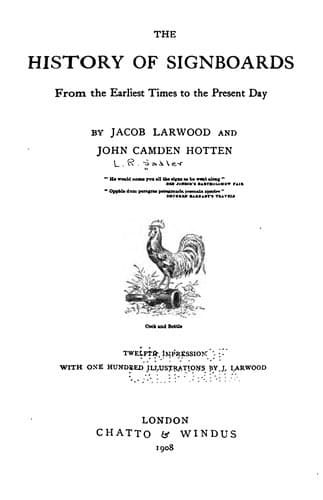
The History of Signboards, from the Earliest times to the Present DayHotten, John Camden
History
The History of Signboards, from the Earliest times to the Present Day
Hotten, John Camden
Inn signs -- England -- History; Signs and signboards -- History
[64] The taverns of the seventeenth century appear in many instances to
have been upstairs, above shops. In 1679, there was a “Mr Crutch,
goldsmith, near Temple Bar, at the _Palsgrave Head_.” In a similar way,
a bookseller lived at the sign of the _Rainbow_, at the same time as one
Farr, who opened this place as a coffee-house. Another bookseller, James
Roberts, who printed most of the satires, epigrams, and other
wasp-stings against Pope, lived at the _Oxford Arms_, a carriers’ inn in
Warwick Lane. Finally, Isaac Walton sold his “Complete Angler” “at his
shopp in Fleet Street, under the _King’s Head_ Tavern.”
[65] Macaulay’s Biographical Essays, Frederick the Great.
[66] Goldsmith’s Essay on the Versatility of Popular Favour.
[67] For more particulars about Topham, _see_ p. 88.
[68] Trades tokens in the Beaufoy Collection.
[69] For several centuries, Fleet Street was the head-quarters for shows
and exhibitions out of fair-time. Ben Jonson speaks of “the City of
Nineveh at Fleetbridge.” This was in the reign of James I. Mrs Salmon’s
waxworks were among the last remaining sights in that locality.
[70] Richardsoniana, p. 140.
[71] Grosley, in his Tour to London, 1772, vol i. p. 150, mentions this
society, which at that period was held at the Robin Hood, and says it
was a semi-public club, into which all sorts of people were admitted,
and all sorts of topics, religious as well as political, were discussed.
He makes an odd mistake, however, when he says that the president was a
baker by trade.
[72] This John Marshall afterwards, when he was appointed the king’s
optician, changed his sign into the ARCHIMEDES AND KING’S ARMS, under
which we find him, in 1718, advertising his “chrystall dressing-glasses
for ladies, which shew the face as nature hath made it, which other
looking-glasses do not.”
[73] Banks’s Collection.
[74] Banks’s Collection.
[75] The Angler. Hawkins’s edition. 1784.
[76] Bagford Bills, Bib. Harl. 5964.
[77] “On the chair of Ben Johnson, now remaining at Robert Wilson’s, at
the sign of the Johnson’s Head, in the Strand.”--_Wit and Drollery_,
1655, p. 79.
[78] _The Newes_, August 24, 1655. This may have been the
above-mentioned tavern, as York House was situated in the Strand on the
site of the present York Buildings.
Public-domain text, read in full here on John Shaqi.
Reviews
Reviews
No reviews yet
Be the first to share your thoughts on this work.
Elsewhere in the archive
Join the Discussion
Join the discussion
Sign in to leave a comment or review.
Sign InorCreate an account