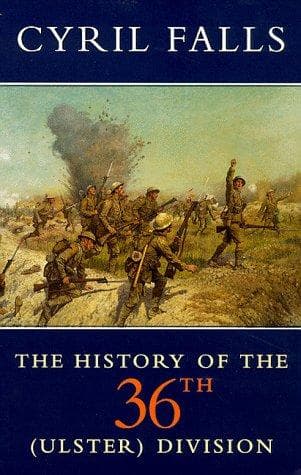
The History of the 36th (Ulster) DivisionFalls, Cyril
History
The History of the 36th (Ulster) Division
Falls, Cyril
Great Britain. Army. Division, 36th; World War, 1914-1918 -- Regimental histories -- Great Britain
In Ireland much had happened meanwhile. A large number of Ulstermen,
the eager spirits who would not wait, had already enlisted. Of these
the greater number had gone to the 10th Division, then being formed.
Others had crossed the Channel and joined Manchester and Glasgow
battalions. At Omagh Captain A. St. Q. Ricardo, D.S.O.,[7] Reserve of
Officers, had been put in charge of the Depot, and in mid-August had,
anticipating the formation of an Ulster Division, begun to recruit
men from the Tyrone Volunteers for a battalion of Royal Inniskilling
Fusiliers. In a very short time he had two companies, which were,
as they had as yet no official status, attached to the 5th and 6th
Battalions of the Royal Inniskilling Fusiliers. In these battalions
some of the officers subsequently elected to remain, and went with
the 10th Division to the Dardanelles. When the Ulster Division
was formed these two companies became the nucleus of the senior
battalion of the 109th Infantry Brigade, the 9th Royal Inniskilling
Fusiliers.[8] This was an exceptional incident, since Captain
Ricardo, before taking up his duties at the Omagh Depot, had been
Adjutant of the Tyrone Regiment, U.V.F. Throughout Ulster, however,
a preliminary recruiting campaign had been carried out, promises to
enlist on the official formation of an Ulster Division being obtained
from members of the U.V.F.
The short delay may have lost a few men to the Ulster Division, but
it had created an atmosphere of expectation and excitement. When
the recruiting officers arrived the men came forward with a rush,
above all in Belfast. A building near the Old Town Hall had been
taken over. As each man came out of the former after attestation,
he entered the latter, was passed from department to department,
emerging from another door a recruit in uniform, leaving his civilian
clothing to be packed up and sent home. In this respect the Ulster
Division was peculiarly fortunate. The men who enlisted in it had not
to endure those weeks of drilling in wet weather in their civilian
clothes, with inadequate boots, which were productive of moral as
well as physical discomfort. For this advantage they were indebted
to the foresight and powers of organization of Captain Craig and
his assistants, the generosity of their friends, and the aid of the
big business men of Belfast; the work being carried out without any
cost to the State. Captain Craig made further visits to the War
Office, on one of which he pointed out to Lord Kitchener that the
camp accommodation in Ulster was insufficient. Lord Kitchener replied
that such details must be arranged by others. Knowing him well from
South African days, when he had learned to regard him with the
highest admiration, Captain Craig answered that it was all very well
to talk in that autocratic manner, but that at present he himself
had not the weight behind him to carry the matter through. The
response was characteristic. Lord Kitchener summoned in succession
Public-domain text, read in full here on John Shaqi.
Reviews
Reviews
No reviews yet
Be the first to share your thoughts on this work.
Join the Discussion
Join the discussion
Sign in to leave a comment or review.
Sign InorCreate an account