The History of the 36th (Ulster) Division — John Shaqi
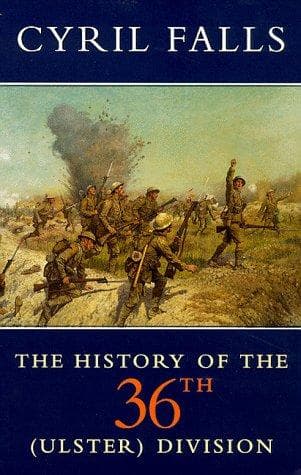
The History of the 36th (Ulster) DivisionFalls, Cyril
History
The History of the 36th (Ulster) Division
Falls, Cyril
Great Britain. Army. Division, 36th; World War, 1914-1918 -- Regimental histories -- Great Britain
the Adjutant-General, the Director of Personal Services, the
Quartermaster-General, and the Director of Fortifications, and said
to them:
"Take Craig away and see that he gets what he requires."
Captain Craig was then able to return to Ireland, and set about the
building of hutted camps at Clandeboye, Ballykinlar, and Newtownards
in the east, and Finner on the Donegal coast.
The organization of the Division proceeded swiftly. A large house,
29, Wellington Place, Belfast, was taken over and equipped as
Headquarters. Three Infantry Brigades were formed: the 107th from the
City of Belfast itself; the 108th from the counties of Antrim, Down,
Armagh, Cavan, and Monaghan; the 109th from Tyrone, Londonderry,
Donegal, and Fermanagh, with one Belfast Battalion. The Pioneer
Battalion was also recruited in County Down, mainly from the Lurgan
area. The Royal Engineers, of which two Field Companies only were
raised at first, the 121st and 122nd, as well as the Divisional
Signal Company, came mainly from Belfast, above all from the great
shipyards. Royal Army Medical Corps personnel was recruited and sent
to Clandeboye, where, on the appointment of an A.D.M.S., Colonel
F. J. Greig, it was formed into three Field Ambulances, the 108th,
109th, and 110th, and moved to Newry. So successful was recruiting
for the R.A.M.C. that Colonel Greig was instructed by the War Office
to raise a Casualty Clearing Station, the 40th, which served both in
France and at Salonika. The Royal Army Service Corps personnel was
fine both in physique and intelligence. The horses were good, as was
natural, seeing how large was the proportion of horses bought for the
Army in Ireland, and among the officers were some excellent horsemen
and horsemasters. Indeed the horsemastership in the Division was
throughout the campaign of a very high order, the Infantry contriving
to keep their mules sleek and fat and the Artillery their gun-horses
fit and well-groomed amid conditions which none can realize who did
not witness them. A Cavalry Squadron and a Cyclist Company were also
formed, the former being unique in that it was a service Squadron of
the Inniskilling Dragoons.
One question which received much attention and gave rise to much
discussion was that of a Divisional Artillery. It was reluctantly
decided not to raise one in Ulster, though this meant losing many
an Ulsterman to other Divisions. The U.V.F. had no artillery and
consequently no partially trained force upon which to draw. It was
thought that the raising and training of artillery in Ulster would
take so long that it might delay the departure to the front of the
Division for several months. In those days, it will be remembered,
the one feverish anxiety of the men of the New Armies was lest the
war should be over ere they were able to play their part in it! In
the event, as will later be explained, the Division went to France
in advance of the Artillery that had been raised for it, with a
Territorial Artillery attached.
Public-domain text, read in full here on John Shaqi.
Reviews
Reviews
No reviews yet
Be the first to share your thoughts on this work.
Join the Discussion
Join the discussion
Sign in to leave a comment or review.
Sign InorCreate an account