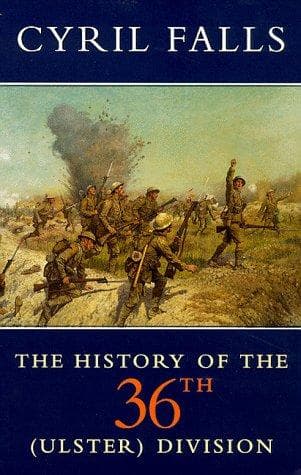
The History of the 36th (Ulster) DivisionFalls, Cyril
History
The History of the 36th (Ulster) Division
Falls, Cyril
Great Britain. Army. Division, 36th; World War, 1914-1918 -- Regimental histories -- Great Britain
André Maurois,[42] the French interpreter
who loves the British so well and pokes such clever fun at them--that
a school "is a plot of ground traversed by imitation trenches, where
officers who have never been near the line teach war-worn veterans
their business."
The swarm of writers which, under the influence of the reaction from
war, has so bitterly criticised the higher staff officers for the
waste of man-power, has been hopelessly astray in its estimation of
the reason. It was not inefficiency or carelessness. It was rather
the Englishman's passion for organization, for orderliness and
smoothness. That passion for perfecting the machine put too many cogs
and fly-wheels upon it, made it over-complicated, clumsy. Ever eager
to expand their business, these directors put into it too much of the
one form of capital which they could not afford--man-power.
In October began preparations for a great new offensive, a surprise
offensive, which was to depend entirely upon the use of tanks. The
scheme and the plans for the Battle of Cambrai must be left for
discussion till the next chapter. Here will be detailed only some of
the preliminary moves. The part of the 36th Division in the first
day's attack was to be confined to the capture of the German trenches
bounded by the Bapaume-Cambrai Road and the Canal du Nord. This was
the task of one Brigade only, and the other two were to be withdrawn
from the Trescault and Havrincourt sectors, each being replaced
by a Division. These Divisions, the 51st (Highland) and the 62nd
(West Riding), were to be kept in rear as long as possible. It fell,
therefore, to the 36th to do much of the work of preparation in
their areas; the repairing of forward roads, the excavating of new
dug-outs, the construction of bridges over trenches. The C.R.E.'s of
these Divisions, with their Pioneer battalions and some Engineers,
moved forward early in November to work under the general control of
the C.R.E., 36th Division. Havrincourt Wood was crammed with little
wooden hutments, which its trees and scrub rendered invisible to
the enemy. One of the most important tasks was the metalling of the
roads, and the dumping of metal beside them in parts where it was
impossible to lay it, in order that work might commence with the
assault. The surface of the roads was good, but only because the
Division had been holding a front so wide, which made the traffic
upon them relatively light. It was quite obvious that a single day of
traffic such as an offensive entails would cut them to pieces. It was
front-line roadmaking upon which the C.R.E., Colonel Campbell, was
required to exercise his ingenuity. Work upon tracks in Havrincourt
Wood was easy; silence was all that was necessary. But work upon what
was to be the most important communication of the IV. Corps in the
offensive, the road from Metz to Ribécourt, was of great difficulty.
In Trescault, half-way between these villages and almost in our front
Public-domain text, read in full here on John Shaqi.
Reviews
Reviews
No reviews yet
Be the first to share your thoughts on this work.
Elsewhere in the archive
Join the Discussion
Join the discussion
Sign in to leave a comment or review.
Sign InorCreate an account