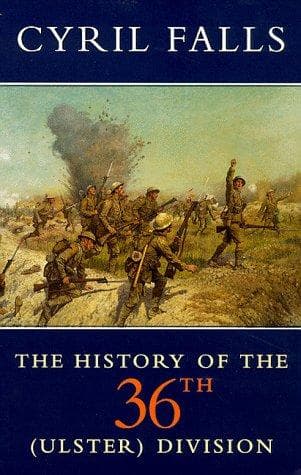
The History of the 36th (Ulster) DivisionFalls, Cyril
History
The History of the 36th (Ulster) Division
Falls, Cyril
Great Britain. Army. Division, 36th; World War, 1914-1918 -- Regimental histories -- Great Britain
line, there were, to begin with, two enormous craters blown by the
enemy before his retirement. These had to be filled in by night, and
it took chalk by the ton to do it. Road-metal also was stacked by
night almost up to the front line, and covered with camouflage before
dawn. Wooden bridges were prepared for all the trenches crossing the
roads which would be required, and most of these for British trenches
set in position. The problem of gun positions on the northern part
of the front was difficult. Cover there was none reasonably far
forward, save among the ruins of Hermies and Demicourt. Among these
the positions were prepared, and by night seven hundred rounds per
18-pounder borne up to them.
During the first sixteen days of November, the 36th Division had
also to provide parties of from two to six hundred men daily for
unloading trains at Ytres station, for the Heavy Artillery ammunition
dump at Bus, and for the Field Artillery dump in Vallulart Wood.
Trains frequently did not arrive within six hours of the advertised
time, and the men had to sit about and wait for them, frequently
half through the night--as ill a preparation for troops on the eve
of an offensive as could well be imagined. Amid much confusion
and unnecessary hardship, one officer earned the gratitude of the
infantrymen by his foresight and consideration, the Staff Captain of
the IV. Corps Heavy Artillery. He required parties up to seventy-five
men, and always at short notice. He kept three of his lorries always
standing by at his headquarters, telephoned when he wanted men,
and fetched them from Ytres, Neuville, Ruyalcourt, or Bertincourt,
as detailed by the General Staff of the Division. Better still, he
generally gave them tea before sending them home, to supplement their
haversack rations.
The weather favoured the British arrangements amazingly. It was fine,
but morning after morning dawned with a thick ground mist which
hung about all day. Foden lorries carrying stone and light steam
rollers to lay it were enabled, beneath this shelter, to work at a
proximity to the Germans that had otherwise been out of the question.
Night after night the tanks, upon which all hinged, moved up into
Havrincourt Wood. Here again the mist was a godsend, for the track of
a tank across country is plain enough on an aeroplane photograph, and
not hard to distinguish with a glass. Contrary to the general belief
of those who have not heard them on the move, the tank is not very
noisy. It was the artillery tractors, dragging up the big howitzers,
which frightened everyone by their clatter.
Public-domain text, read in full here on John Shaqi.
Reviews
Reviews
No reviews yet
Be the first to share your thoughts on this work.
Elsewhere in the archive
Join the Discussion
Join the discussion
Sign in to leave a comment or review.
Sign InorCreate an account