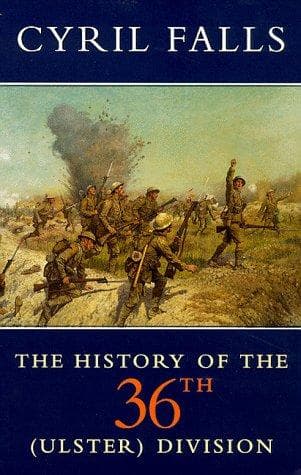
The History of the 36th (Ulster) DivisionFalls, Cyril
History
The History of the 36th (Ulster) Division
Falls, Cyril
Great Britain. Army. Division, 36th; World War, 1914-1918 -- Regimental histories -- Great Britain
The 36th Divisional Artillery was raised, six months after the rest
of the Division, in the suburbs of London, though from quarters
stranger to one another than towns fifty miles apart in Ireland.
The 153rd and 154th Brigades R.F.A. were formed by the British
Empire League, of which one of the moving spirits was General Sir
Bindon Blood. They were recruited chiefly from Croydon, Norbury, and
Sydenham. The 172nd and 173rd Brigades, on the other hand, came from
North-east London. They were formed on the initiative of the Mayors
of East and West Ham and recruited from those districts.
The first date recorded in the Artillery annals is that of May the
5th, 1915, when sixty recruits of the 153rd Brigade assembled at
60, Victoria Street, the headquarters of the British Empire League,
and marched to Norbury, where they were billeted in private houses.
Londoners from South and North did not meet until July, when the
four Brigades and the 36th Divisional Ammunition Column were moved
to Lewes. It was within a few days of the arrival of the rest of the
Division, already at a high standard of efficiency, in England, that
serious training of the Divisional Artillery really began.
To the great regret of all Ulster, it was ruled that Sir George
Richardson, owing to the seniority of his rank, could not take
command of the Division. He remained in Belfast, working for the
good of the cause, and none can speak more highly of his efforts
and his loyalty than Sir James Craig and General Hickman, the chief
organizers of those early days. "Trusted by every class," writes an
officer who had long worked on his staff, "he was able to induce
employers to permit those of their workmen to enlist who were not
indispensable, and to perform the much more difficult task of making
the skilled craftsmen of the shipyards realize that their duty to
their country called them to remain at work, helping the Navy and
Merchant Service to hold command of the sea, on which our success
depended equally with our victory on land." How they and others,
notably the makers of linen for aircraft, who were, for the most
part, women, played their part, cannot be discussed here, though it
is a record worthy the pen of a eulogist. What is less generally
known to the people of Great Britain is that in Ulster not a strike
occurred throughout the course of the war.
Major-General C. H. Powell, C.B.,[9] an officer with a distinguished
record in the Indian Army, was appointed to the command of the
Division. Colonel Hickman, after remaining in Belfast till the three
Brigades had been formed, went to Finner to take command of the 109th.
The following is the formation of the Division as finally
constituted:--
COMMANDER:
Major-General C. H. POWELL, C.B.
ASSISTANT ADJUTANT AND QUARTER-MASTER GENERAL:
Lieut.-Colonel JAMES CRAIG.
GENERAL STAFF OFFICER, 2ND GRADE:[10]
Captain W. B. SPENDER.[11]
ROYAL ARTILLERY.[12]
(Brigadier-General H. J. BROCK.)
Public-domain text, read in full here on John Shaqi.
Reviews
Reviews
No reviews yet
Be the first to share your thoughts on this work.
Join the Discussion
Join the discussion
Sign in to leave a comment or review.
Sign InorCreate an account