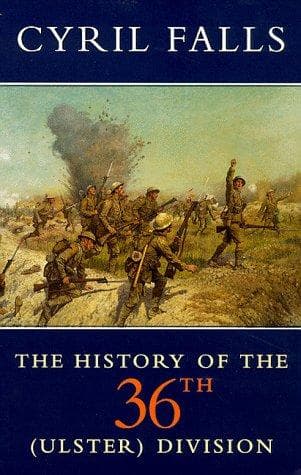
The History of the 36th (Ulster) DivisionFalls, Cyril
History
The History of the 36th (Ulster) Division
Falls, Cyril
Great Britain. Army. Division, 36th; World War, 1914-1918 -- Regimental histories -- Great Britain
The relief of the 107th and 108th Brigades took place on the nights
of the 17th and 18th of November. To deceive the enemy as to the
great concentration in front of him, a screen of the troops of these
Brigades remained to hold the outpost line. These men knew only that
a raid on a large scale was intended. In the early hours of the
18th, the Germans, evidently somewhat suspicious, raided a sap held
by the 1st Irish Fusiliers behind a heavy "box" barrage, and took six
prisoners. From the evidence of German prisoners taken subsequently,
it appeared that the most the enemy gathered from the examination
of his captives was that an attempt to capture Havrincourt might be
expected. This aroused in the German command no great uneasiness. On
the 16th, the 14th Rifles had taken over the whole front of the 109th
Brigade to permit the other battalions to train for their task, This
training was carried out by General Ricardo over trenches laid out to
scale with the plough, upon a front of four thousand yards.
Accommodation was so limited that much marching and counter-marching
was necessary to provide billets for the 51st and 62nd Divisions
moving up. In its course the 108th Brigade moved back as far as
Barastre, upwards of eight miles from the front line. By the
night of the 19th, however, the eve of the attack, the infantry
was concentrated well forward. The whole of the 109th Brigade was
in assembly positions, the 108th Brigade in Vélu Wood, and the
107th Brigade in the area Ytres-Lechelle. The 16th Rifles were in
Havrincourt Wood.
These details have been here given in order that the next chapter
may proceed with the scheme of the Battle of Cambrai, without
interruption to explain the moves which preceded it. It is in itself
one of the most interesting actions in which the 36th Division took
part during its combatant career, and, at the same time, measuring
final result by the standard of early achievement, one of the most
disappointing. The material results that it produced were small, but
it opened a new era in the history of war. No adequate conception of
the victories of 1918, first of the Germans, then of the Allies, can
be reached without a close study of its lessons.
FOOTNOTES:
[41] The expression "front Hindenburg Line" was applied loosely
either to the front-line trench of the first system, or to the whole
of that system. The word "system" will be used in this and succeeding
chapters to avoid misunderstanding.
[42] Author of two classic books on the humours of war: _The Silence
of Colonel Bramble_ and _General Bramble_.
CHAPTER VIII
CAMBRAI AND AFTER (I): NOVEMBER 20TH TO 22ND, 1917
Public-domain text, read in full here on John Shaqi.
Reviews
Reviews
No reviews yet
Be the first to share your thoughts on this work.
Elsewhere in the archive
Join the Discussion
Join the discussion
Sign in to leave a comment or review.
Sign InorCreate an account