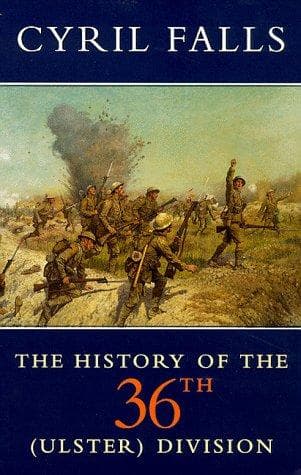
The History of the 36th (Ulster) DivisionFalls, Cyril
History
The History of the 36th (Ulster) Division
Falls, Cyril
Great Britain. Army. Division, 36th; World War, 1914-1918 -- Regimental histories -- Great Britain
The year 1917 had drawn to its close leaving unfulfilled most of the
high hopes that had buoyed men's spirits in the opening months. Some,
at least, of the causes of their downfall were far away from the
Western Front, and beyond the control of Generals Nivelle, Pétain,
and Sir Douglas Haig. Russia, that strong-armed but weak-headed
and weak-legged giant, had collapsed, leaving Roumania to its
fate--complete overthrow. At Carporetto the Italians had been heavily
defeated by the Austro-German armies, and France and England had
been forced to send divisions to Italy to act as rallying points
of resistance. In France the Champagne offensive had left a legacy
of doubt and exasperation among soldiers as well as civilians, and
it had taken all the fostering skill and care of General Pétain
to restore his troops to the standard at which they had begun
the year. The Flanders offensive, vitally necessary, crippling
to Ludendorff, as he has admitted in his book, had been unduly
prolonged in conditions far more dreadful even than when the 36th
Division had taken part in it. Not men only but horses were drowned
in the shell-holes ere it was over, and by the time Poelcappelle and
Passchendaele had been reached the evacuation of wounded had become
all but impossible. The heights were won, indeed, on the southern
flank, though at Westroosebeke the enemy still had the best ground,
but, broadly speaking, the strategical value of the advance was _nil_.
Passchendaele, indeed, had resolved itself into a terrible
object-lesson. Here was the point to which a mechanical conception of
warfare had led us. Was there not, the keenest minds in every army
were asking, was there not some outlet? Were men to be forever at the
mercy of the munition factory and the mud of its making, the roll of
barbed wire, the slab of reinforced concrete? Was the real genius of
the soldier never to have the chance to display itself outside this
war of fortifications? Often one heard the question, academic enough,
but of extraordinary interest: "Could supreme genius, could the
greatest captain that ever lived, could Napoleon have freed his hands
from the deadlock?" The greatest soldier of this war has revealed,
in the incomparable language that is his gift, that he also had
asked himself that question, and answered it unhesitatingly in the
affirmative.[43] As affairs were now marching, it did indeed appear
as though we were reverting to the mere tactics of the battering-ram,
as though, metaphorically speaking,
"Elephants
And barbèd horses might as well prevail
As the most subtle stratagems of war."
And a way out from mechanism was found, as might have been expected,
in mechanism.
Public-domain text, read in full here on John Shaqi.
Reviews
Reviews
No reviews yet
Be the first to share your thoughts on this work.
Elsewhere in the archive
Join the Discussion
Join the discussion
Sign in to leave a comment or review.
Sign InorCreate an account