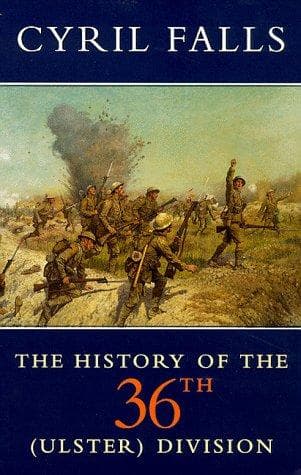
The History of the 36th (Ulster) DivisionFalls, Cyril
History
The History of the 36th (Ulster) Division
Falls, Cyril
Great Britain. Army. Division, 36th; World War, 1914-1918 -- Regimental histories -- Great Britain
Whose the credit for the conception of the surprise tank assault,
whether General Tudor's or General Ellis's, or another's, it is not
here pertinent to speculate. The germ of the idea was inherent in the
tank itself, and must have been present, vaguely or clearly, in the
minds of all who contributed to its design and organization. Here, at
any rate, had been found an ideal testing-ground for the scheme, good
ground, obstacles which it would have, at that date, been madness to
attack in the conventional manner, the prospect of inflicting upon
the enemy a swift and signal defeat. Moreover, a blow that would
prevent the massing of more German divisions on the Italian front,
where every German division put new life and dash into at least two
Austrian, was urgently needed. The striking of the blow was entrusted
to General Byng's Third Army.
The plan was simple. The tanks were to roll out gaps in the wire
of the Hindenburg System, through which the infantry columns could
push. The aim was to overcome the enemy holding the line between
the Canal du Nord and the Canal de l'Escaut, which runs parallel
with it at a distance of from six to eight miles further east; to
secure possession of the area bounded by these Canals on east and
west, and by the marshes of the Sensée River to the north; and, as
a consequence, to clear the whole area west of the Canal du Nord of
hostile forces. It must be remembered that the German line, running
north from Havrincourt to Mœuvres, there turned west by north. Had
the British, pressing northward, reached Oisy-le-Verger and the
banks of the Sensée River, they would have been ten miles behind the
German front line at that latitude. A precipitate retreat would have
been certain, and a very large haul, if not of prisoners, at least
of material, almost equally so. Even if the advance to the north
accomplished no more than the consolidation of the high ground round
Bourlon Wood, the Germans would have to abandon the Drocourt-Quéant
Switch, a very strong position. The battle was to have three stages:
the first, a surprise infantry attack assisted by tanks and an
unregistered artillery barrage to capture the crossings of the Canal
de l'Escaut at Masnières and Marcoing, and a German trench east of
them known as the Masnières-Beaurevoir Line; the second, the advance
of the Cavalry Corps to isolate the city of Cambrai, and seize the
crossings of the Sensée River, while the troops of the IV. Corps
captured Bourlon Wood; and the third, the clearance of the area and
of Cambrai itself. The attack was to be carried out by the III.
Corps on the right and the IV. Corps on the left, with the V. Corps
in reserve. The right flank of the attack lay upon the great spur,
crowned by the Bois Lateau and the hamlet of Le Pave, running from
Gonnelieu to the Canal de l'Escaut at Crèvecœur; the left roughly
upon the Canal du Nord. There was to be a subsidiary attack to the
north upon the Hindenburg Line at Bullecourt. If one were to search
Public-domain text, read in full here on John Shaqi.
Reviews
Reviews
No reviews yet
Be the first to share your thoughts on this work.
Elsewhere in the archive
Join the Discussion
Join the discussion
Sign in to leave a comment or review.
Sign InorCreate an account