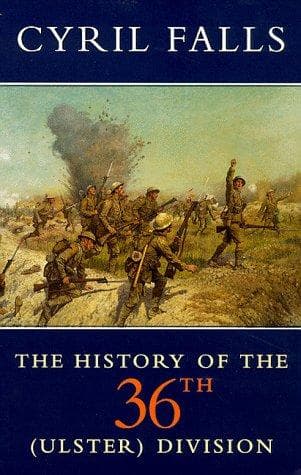
The History of the 36th (Ulster) DivisionFalls, Cyril
History
The History of the 36th (Ulster) Division
Falls, Cyril
Great Britain. Army. Division, 36th; World War, 1914-1918 -- Regimental histories -- Great Britain
for a key-word to define the general idea of the offensive, that
key-word would probably be "exploitation." It was not intended merely
to break through the enemy's defences, to strike him a heavy blow; it
was designed to exploit a preliminary success, to clear a great tract
of country of hostile troops, to turn a flank; for, be it remembered,
the advance to the Sensée marshes would have involved not merely a
headlong retreat or wholesale capture for the German troops south of
them, but an eventual retirement of several miles at least to the
north. The Drocourt-Quéant Switch, the main Hindenburg Lines, would
be gone. Cambrai was, for the Western Front, a small battle, but
great events hung upon it.
In the previous accounts of battles it has not been necessary, for
the purpose of writing the History of the 36th Division, to do more
than glance at the progress of the Divisions fighting upon its
flanks. In this battle, on the contrary, if any adequate conception
is to be reached from the account, the plan and the action of the IV.
Corps, that is, of the two Divisions on the right of the 36th, and
the 56th Division, which was under the orders of the IV. Corps for
the greater part of the action, must be studied in some detail. The
right boundary of the IV. Corps was the Trescault-Ribécourt Road;
thence north of Noyelles. It was to attack with three Divisions, the
51st on the right, the 62nd in the centre, and the 36th on the left.
The 51st and 62nd Divisions, the left of the latter on the Canal du
Nord, were to advance north from the skirts of Havrincourt Wood. The
normal northern objective of the first day was the Bapaume-Cambrai
Road. If, however, there was little opposition, the 51st and 62nd
Divisions were to press on and take the high ground crowned by
Bourlon Wood and village, or take them over from the Cavalry if the
latter had occupied them, while the 107th and 108th Brigades of the
36th Division moved parallel with them east of the Canal, formed a
flank-guard facing west, and seized the passages of the Canal at
Mœuvres and Inchy-en-Artois. In the event of serious opposition this
later programme was to be that of the next day. The primary task of
the 36th Division was to capture the German trenches west of the
Canal du Nord and south of the Bapaume-Cambrai Road. For this it
was to employ one Brigade, the 109th, one of its Field Artillery
Brigades, the 173rd, together with the 280th Brigade and the 93rd
Army Brigade R.F.A. Its other Artillery Brigade, the 153rd, was at
the disposal of the 62nd Division, to take part in its preliminary
barrage. The plans were entrusted to General Ricardo, who worked them
out with his Artillery Group Commander, Lieut.-Colonel H. C. Simpson,
D.S.O., and had thus an almost unique opportunity for a Brigadier
on the Western Front of fighting his own battle in his own fashion.
Communication across the Canal was to be established by the erection
of a bridge on the Demicourt-Flesquières Road, to take wagons and
Public-domain text, read in full here on John Shaqi.
Reviews
Reviews
No reviews yet
Be the first to share your thoughts on this work.
Elsewhere in the archive
Join the Discussion
Join the discussion
Sign in to leave a comment or review.
Sign InorCreate an account