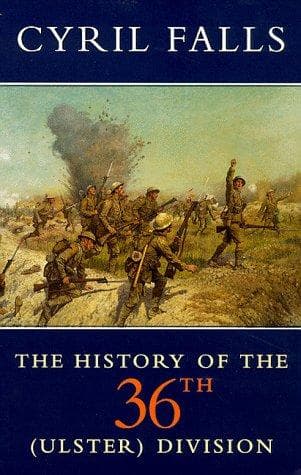
The History of the 36th (Ulster) DivisionFalls, Cyril
History
The History of the 36th (Ulster) Division
Falls, Cyril
Great Britain. Army. Division, 36th; World War, 1914-1918 -- Regimental histories -- Great Britain
It was anticipated by the enemy. At 9-20 he counter-attacked upon the
front of the 51st and 62nd Divisions. The latter lost no ground on
its right, but its extreme left flank fell back for a short time on
to the Bapaume-Cambrai Road, subsequently reoccupying its position.
Worse fortune met the British further east, where the 51st Division
lost Fontaine. During the counter-attack there occurred one very
remarkable incident. A battery of machine-guns of the 36th Division
was in action in the open, pushed forward much too far, half-way
between Lock 5 and the factory on the Bapaume-Cambrai Road, when
it was attacked at close quarters by a company of the enemy. The
officer and section sergeant were killed and the guns surrounded. Two
guns of another battery were brought into action by Major Miller,
the Divisional Machine-Gun Officer, at little over a hundred yards'
range. The effect was withering, the Germans melting away before the
fire, saving themselves by jumping into trenches or crouching in
shell-holes. When quiet had supervened, a machine-gun officer counted
forty-two dead Germans about the recaptured position.
The attack of the 36th Division was launched at 11 a.m., after a
forty minutes' bombardment. On the right the leading company of the
15th Rifles reached its objective, gaining upwards of five hundred
yards of the Hindenburg trenches. The companies which passed through
it had a more difficult task. The trenches of the second line were
here but half dug, and this, seeing that the attack was working
up along them, was to the advantage of the defenders. The Germans
established a block above a length of trench about a foot deep, and
beat off every attempt by machine-gun fire. At dusk the 10th Rifles
made an attempt to rush the machine-guns, but could not get near
them, losing six officers in trying to do so.
West of the Canal things went better at the opening. The 12th
Rifles attacked Mœuvres with three companies in line. The two on
the left penetrated the village, but the right company was held
up by machine-guns in the Hindenburg Support System. On the left,
troops of the 56th Division, bombing up the Hindenburg Front System,
captured Tadpole Copse. Colonel Goodwin, commanding the 12th Rifles,
now handled his battalion with great skill. He ordered his right
company to bomb its way up the trench leading from the sunken
Mœuvres-Graincourt Road to the Hindenburg Support System, while the
other companies exploited their semi-success in the village. The
right company did succeed in reaching the front trench of the Support
System, and in clearing it, but the second line was full of Germans
and could never be reached. Meanwhile the centre and western side of
the village had been cleared, many Germans being killed in dug-outs
and cellars. Pushing on through the village, the Riflemen took the
trench on the western edge, fringing the cemetery, and began to
consolidate it. Then came the counter-attack.
Public-domain text, read in full here on John Shaqi.
Reviews
Reviews
No reviews yet
Be the first to share your thoughts on this work.
Elsewhere in the archive
Join the Discussion
Join the discussion
Sign in to leave a comment or review.
Sign InorCreate an account