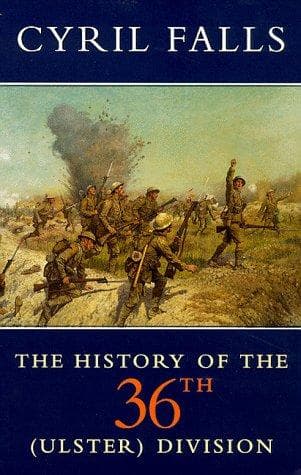
The History of the 36th (Ulster) DivisionFalls, Cyril
History
The History of the 36th (Ulster) Division
Falls, Cyril
Great Britain. Army. Division, 36th; World War, 1914-1918 -- Regimental histories -- Great Britain
The Infantry of the 36th Division was formed on perhaps the most
strictly territorial basis of any Division of the New Armies; the
general rule being that battalions were drawn from the larger
regimental areas of the U.V.F., companies from the smaller, and
platoons from battalion areas. This had the great advantage that
it engendered a natural companionship and spirit of pride in the
units. The company, the platoon, was a close community, an enlarged
family. In after days, in the trenches and in billets behind the
lines, the talk, not only of men from Belfast and the larger towns,
but of those from the country villages, would be of streets and, in
the latter case, of farms and lanes of which those present had known
every detail from childhood. The old clan-names of the Northumbrian
and Scottish Borders were clustered thick together. A platoon would
have five Armstrongs or Wilsons or Elliots, a company half a dozen
Irvines or Johnstons, a battalion half a score of Morrows or Hannas.
To be set against that great accretion of moral force which springs
from such a survival of the clan was the minor disadvantage that
the non-commissioned officers for the most part, and certainly all
the juniors amongst them, were the brothers and cousins and close
companions of the men they commanded. It was not that their orders
were disobeyed; it was rather that there was at first a diffidence
about the orders, which sometimes appeared to be rather in the nature
of persuasive requests. In a few units the non-commissioned officers
were changed about, so that they came in contact with men with whom
they were less familiar. But the problem was never a serious one,
and it finally disappeared. The only other disciplinary problem was
that of week-end leave. The great bulk of the men of the 107th and
108th Brigades and most of the Divisional Troops were training near
their homes. They could not understand why they should be kept in
camp doing nothing on Sundays when they might have been visiting
them. Though leave was given generously enough, this remained a sore
point till the Division moved to England. Apart from "absence without
leave" there was no crime to speak of. Such occasional blackguards
as were found in the ranks were swiftly disposed of, a sentence of
"discharged as incorrigible and worthless," which was, as a fact,
quite illegal in time of war, being their fate.
Public-domain text, read in full here on John Shaqi.
Reviews
Reviews
No reviews yet
Be the first to share your thoughts on this work.
Join the Discussion
Join the discussion
Sign in to leave a comment or review.
Sign InorCreate an account