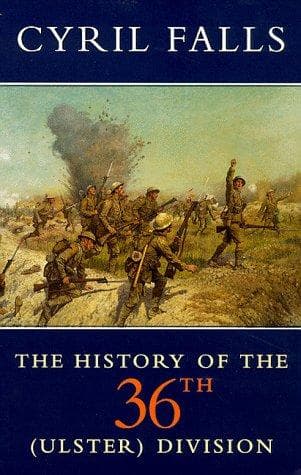
The History of the 36th (Ulster) DivisionFalls, Cyril
History
The History of the 36th (Ulster) Division
Falls, Cyril
Great Britain. Army. Division, 36th; World War, 1914-1918 -- Regimental histories -- Great Britain
The Divisional Commander was a firm believer in marching, not only
as a preparation for that feature of military life, but as a creator
of toughness and endurance to meet the varied strain of war. By
the early months of 1915 one brigade route march of from twenty
to twenty-five miles, and shorter battalion marches each week,
had become the general rule. Equipment being slow in making its
appearance, General Powell had rucksacks, of the Alpine pattern,
made in Belfast, to be carried, fully loaded, on the march instead
of the pack, and bolts from the shipyards to take the place of
small-arm ammunition in the pouches. There was, as might be expected,
some grumbling at what appeared to be a needless imposition, but
the troops benefited by the experience, and Sir Archibald Murray,
when they marched past him the following summer, remarked how
easily they carried their packs. Numerous recruiting marches were
also carried out, which provided further training in marching and
march-discipline, and at the same time exhibited detachments of the
units from the countryside to the remotest villages in their area.
Everywhere they were received with the greatest pride and enthusiasm.
For the rest, the training was that of all the New Armies. The
Infantry had "D.P." rifles, the R.E. for a long time no material
save what was bought for them. Little musketry could be carried out,
such as there was being done with a handful of short service rifles
allotted to each battalion, and in some cases with rifles borrowed
from the U.V.F.--upon which inspecting Generals turned a blind eye.
By Infantry and Sappers alike trenches were dug, as an officer of
the latter acidly remarks, about eighteen inches wide and with
perpendicular sides. But that, of course, was a universal experience.
Much discussion took place upon the relative merits of trenches
sited upon the forward and reverse slopes of undulating ground.
Not till 1918, and then to an extent but small, was any choice to
be left by the enemy in the siting of positions. The R.A.M.C. was
the first to be equipped. The people of Ulster showed its affection
for its Division by the presentation of very fine motor ambulances,
each of which bore inscribed upon the body the name of the town or
association from which it came. In some of these cars the gangway was
sufficiently wide to take two additional stretchers, which proved an
inestimable boon in the Battle of the Somme.
[Illustration: MAJOR-GENERAL SIR C. H. POWELL, K.C.B.]
Public-domain text, read in full here on John Shaqi.
Reviews
Reviews
No reviews yet
Be the first to share your thoughts on this work.
Join the Discussion
Join the discussion
Sign in to leave a comment or review.
Sign InorCreate an account