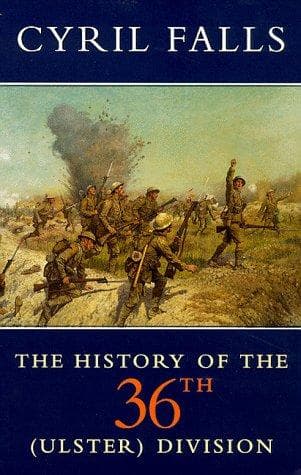
The History of the 36th (Ulster) DivisionFalls, Cyril
History
The History of the 36th (Ulster) Division
Falls, Cyril
Great Britain. Army. Division, 36th; World War, 1914-1918 -- Regimental histories -- Great Britain
Snowbound as they were, the troops of the 36th Division passed
several days in the most agreeable conditions. One day there might
be snow-fall; the next might succeed with keen frost, but there was
no lack of timber for fuel, and the amenities of civilization were
very welcome to men who for five months had dwelt amid devastation.
Training was practically impossible owing to the depth of the snow in
the fields, but some musketry was carried out on a good rifle-range
near Lucheux. The Artillery, having been relieved by that of the
63rd Division on Christmas Day, got no further than the Beaulencourt
staging area, where it remained hemmed in by drifts.
The rest was, as usual, all too short, particularly in view of the
exhausted condition of the troops. Immediately after Christmas the
Division was again on the move, to the area Corbie-Boves-Moreuil.
Brigade groups went by rail, the transport by road, staging at
Puchevillers and Contay. The latter met with difficulties equal to
those following the relief. Many lorries were stuck in drifts. In
some cases the trains even were considerably delayed.
The British Army was extending its flank, taking over from the French
a front far greater than it had ever held, even at the time of the
German retirement of 1917, when its right had been on the Amiens-St.
Quentin Road. This is not the place to discuss the wisdom of that
extension, or supposing, as few will deny, that it was in itself
reasonable, of its magnitude. Suffice it to say that Sir Douglas
Haig now found himself seriously short of reserves. The relief of
successive French divisions was being slowly effected, and the
progress of the 36th Division was leisurely. It remained five days at
rest in the Corbie area, where it was joined by its Artillery. Then
it went slowly forward, _via_ Harbonnières, to the area of Nesle, a
town left undamaged by the Germans in their retirement, into which
they had herded civilians, old men, women, and children, from other
towns and villages destroyed by them. Here Divisional Headquarters
were established on January the 12th. That night the 107th Brigade
relieved a regiment of the 6th French Infantry Division astride the
Somme before St. Quentin, remaining under the orders of the French
Divisional Commander. The night following the 109th Brigade relieved
the other French regiment in line, command passing to General Nugent
at 10 a.m. on the 14th, when Headquarters took over from those of
the 6th French Division at Ollézy. The 108th Brigade was billeted in
villages on the Ham-St. Quentin Road, with headquarters at Dury. The
Divisional Artillery had been joined by the 14th Army Field Artillery
Brigade. The relief of the French artillery was not complete till the
15th.
Public-domain text, read in full here on John Shaqi.
Reviews
Reviews
No reviews yet
Be the first to share your thoughts on this work.
Elsewhere in the archive
Join the Discussion
Join the discussion
Sign in to leave a comment or review.
Sign InorCreate an account