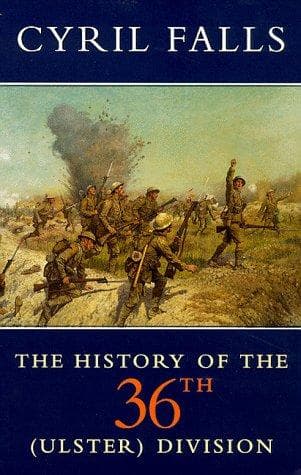
The History of the 36th (Ulster) DivisionFalls, Cyril
History
The History of the 36th (Ulster) Division
Falls, Cyril
Great Britain. Army. Division, 36th; World War, 1914-1918 -- Regimental histories -- Great Britain
The retirement began at 10-30 p.m., being covered by small
rearguards. In the darkness the troops were not seriously pressed
by the Germans. Long before dawn all battalions were established
in their new positions, the three Brigade Headquarters of the 36th
Division being at Lavesne, and that of the 61st Brigade in the old
Divisional Headquarters at Ollézy. General Nugent had meanwhile
transferred his headquarters to Estouilly, north of Ham. It must be
remembered that each Brigade had by now had one battalion almost
completely destroyed, and that the Battle Zone battalions were at an
average strength of about two hundred and fifty men. There was an
accretion in artillery strength. Two batteries, A/91st and C/91st, of
the 20th Divisional Artillery, together with the 232nd Siege Battery,
were put at the disposal of the 36th Division, and remained with it
throughout the retreat, though there were constant changes in the
formation of Groups. The Siege Battery was later transferred to a
special Heavy Artillery Group, with two others, directly under the
orders of the 36th Divisional Artillery.
The destruction of bridges and pontoons allotted to the Engineers of
the 36th Division was carried through without hitch. Shortly after
noon the pontoon and foot-bridge at Fontaine were destroyed by the
121st Field Company, which in the small hours of the 22nd of March
blew up the whole group of bridges between Grand Séraucourt and
Le Hamel. Later, in daylight, the 150th Field Company blew up the
Artemps Group. The Tugny and St. Simon bridges had been allotted
to other sections of the company. Lieutenants C. L. Knox and J. B.
Stapylton-Smith were each responsible for twelve bridges. The first
warning received by the former was when the débris of the Artemps
bridges floated down-stream. He at once commenced his task. Several
of the bridges were destroyed under machine-gun fire. At Tugny,
the Germans were advancing on the main steel-girder bridge when
the time-fuse failed. The night dew or the mist had spoiled it. As
Lieutenant Knox rushed forward the foremost of the enemy were upon
the bridge, a long one. He tore away the useless time-fuse, clambered
under the frame-work of the bridge, and lit the instantaneous fuse.
The bridge was destroyed, and, by some miracle, Lieutenant Knox was
uninjured. He received the Victoria Cross. Among many heroic actions
performed by officers and men of the Division in the course of the
war it would be difficult to point to one of finer calibre. At St.
Simon, Lieutenant Stapylton-Smith blew up a large number of the enemy
with one of the three main bridges.
Public-domain text, read in full here on John Shaqi.
Reviews
Reviews
No reviews yet
Be the first to share your thoughts on this work.
Elsewhere in the archive
Join the Discussion
Join the discussion
Sign in to leave a comment or review.
Sign InorCreate an account