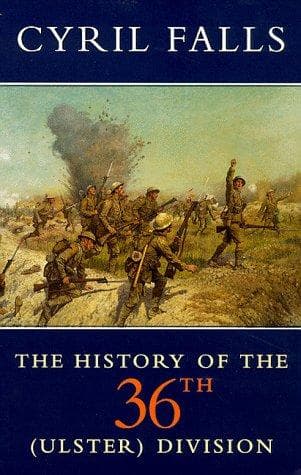
The History of the 36th (Ulster) DivisionFalls, Cyril
History
The History of the 36th (Ulster) Division
Falls, Cyril
Great Britain. Army. Division, 36th; World War, 1914-1918 -- Regimental histories -- Great Britain
Early in July the Division moved to Seaford, on the Sussex coast,
leaving the 9th Inniskillings to recruit at Ballycastle from the
shameful disease of German measles! But a small proportion of those
15,000 men had ever previously crossed the Irish Sea. The English
were new to them, as they were to the English. The impressions
made on either side were favourable. The men were treated with
the greatest kindliness, and, for their part, their behaviour was
excellent; reassuring, indeed, to some of those residents who had
been perturbed at the idea of this incursion of "wild Irishmen." Not
a few of the people of Seaford, on seeing the announcement of this
History in the press, wrote to the author and spoke of their pleasant
memories of the Ulstermen's sojourn in the district. Seaford made a
fine training area. It was a healthy place, and the splendid downs
behind the town were ideal for tactical exercises. Soon they were
scored with white chalk trenches. On one occasion, when the whole
Division, with the exception of the Artillery--Infantry, Cavalry,
Cyclists, Engineers, R.A.S.C., and R.A.M.C.--had been engaged in
night manœuvres, it was discovered when dawn broke that a deep trench
had been cut across a very valuable gallop belonging to an Alfriston
training stable. An apologetic letter was sent to the owner, who
wrote back expressing his pleasure that his ground had been put to a
purpose so useful, offered half his jumps to the mounted units and
young officers for practice, and scarcely hinted that he hoped the
occurrence would not be repeated.
In the last week of July, when the troops were carrying out
their usual routine of training, a message was received that
Lieutenant-General Sir Archibald Murray, Deputy Chief of the General
Staff, would hold an immediate inspection. The result was of great
importance. Sir Archibald Murray informed Lord Kitchener on his
return that the Ulster Division was worthy of a higher place than it
occupied on the latter's private list of troops for the front. It was
not Lord Kitchener's fashion to ponder such questions.
"I'll go and see them to-morrow!" was his reply.
At half-past four on the 26th of July came a telephone message
that the Division was to parade for Lord Kitchener at 11 a.m. the
following day.
July the 27th was a bright, sunny day. Lord Kitchener came, dashed
at the waiting horses with such speed that before anyone could
speak he was on the back of one with a doubtful reputation, by no
means intended for his riding, and rode off. Colonel FitzGerald,
his Military Secretary, said he had never seen him better pleased,
and was quite unable to persuade him to leave the field for another
engagement. To General Powell he remarked that he was relieved to
find he had under his hand a Division ready for the front at a
moment's notice.
Public-domain text, read in full here on John Shaqi.
Reviews
Reviews
No reviews yet
Be the first to share your thoughts on this work.
Join the Discussion
Join the discussion
Sign in to leave a comment or review.
Sign InorCreate an account