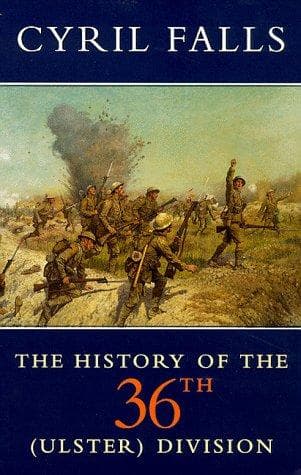
The History of the 36th (Ulster) DivisionFalls, Cyril
History
The History of the 36th (Ulster) Division
Falls, Cyril
Great Britain. Army. Division, 36th; World War, 1914-1918 -- Regimental histories -- Great Britain
At 10-30 p.m. orders were received from the 19th Division for an
immediate withdrawal west of Wulverghem. This was carried out
before dawn, the line pivoting back on the left of the 12th Rifles,
which joined up with the 178th Brigade west of the village. It was
completed only just in time. With morning light the Germans opened an
intense bombardment on the new position, which, for the greater part
of its length, followed no old British trench. An infantry attack
followed, and bodies of Germans broke through at the junction of the
12th Rifles and 178th Brigade. A counter-attack by the 1st Irish
Fusiliers and the scanty reserves of the 12th Rifles, led by Major
Holt Waring, failed to restore the position, but prevented the enemy
gaining further ground on the left. Major Waring, a most gallant
officer and a born leader of men, was killed. The left and centre of
the 12th Rifles were very wisely withdrawn a few hundred yards to a
famous communication trench of old days, known as "Kingsway." From
this there was a fairly good field of fire. The 9th Irish Fusiliers
had now been moved up from the Kemmel defences, and was ordered to
send up two platoons to connect the right flank in "Kingsway" with
the original line west of Wulverghem. These two platoons had an
unfortunate fate. At dusk they were almost surrounded by groups of
the enemy pressing forward, and were forced to fall back some hundred
yards with heavy casualties.
At 2-15 a.m. on the 16th the little remnant of the Brigade began to
withdraw on relief, covered by small outposts. It then marched back
to a camp near La Clytte, suffering numerous casualties on its route
from shell-fire. Four machine-guns remained near Kemmel village.
The enemy was now indulging in what were known to artillerymen as
area bombardments, concentrating upon half a square mile of country
for half an hour, then switching his batteries to another. Such
methods are ineffective unless based upon an enormous mass of heavy
artillery. With this available, as it was on this occasion, they
are extraordinarily noxious and demoralizing. Reserves, tired units
withdrawn for a short rest, are kept constantly on the strain, ever
wondering when their turn is coming, compelled hurriedly to shift
position when it does. Severe loss and disorganization are caused to
transport piqueted in the open or bringing up rations and munitions.
A spot undisturbed at one minute becomes the centre-point of a
hellish tornado at the next.
Public-domain text, read in full here on John Shaqi.
Reviews
Reviews
No reviews yet
Be the first to share your thoughts on this work.
Elsewhere in the archive
Join the Discussion
Join the discussion
Sign in to leave a comment or review.
Sign InorCreate an account