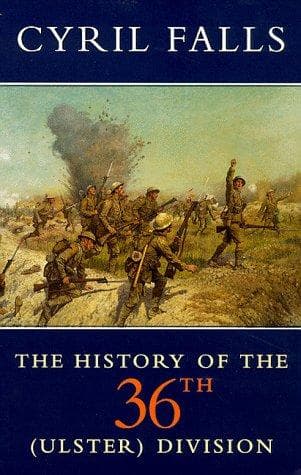
The History of the 36th (Ulster) DivisionFalls, Cyril
History
The History of the 36th (Ulster) Division
Falls, Cyril
Great Britain. Army. Division, 36th; World War, 1914-1918 -- Regimental histories -- Great Britain
April the 16th, while the men of the 108th Brigade, wearied out
and dazed by shell-fire, snatched what rest they could, was the
occasion of furious fighting at Wytschaete. The village was lost in
the morning, and retaken by a magnificent counter-attack of those
veritable paladins of modern war, the Highland Brigade of the 9th
Division. It could not be held on the morrow owing to its isolation,
and the line had to be withdrawn to the neighbourhood of the old
British trenches of 1917. The 17th, to many observers, appeared the
blackest day they had seen. Almost everywhere the gains of years of
desperate fighting had been lost. Passchendaele and Poelcappelle--to
which there will be further reference when we return to the fortunes
of the 36th Division--were gone. Huge slices of territory on which
the Germans had never stood, or over which they had been hustled in
retreat, were now in their possession. Bailleul, which had been at
many periods a Corps Headquarters, had fallen. From villages such
as Westoutre, where they had lived in comparative peace since 1914,
the villagers were rushing out under shell-fire, pushing barrows,
staggering under the burden of huge bundles, across the fields.
Men asked whether we had any reserves remaining, whether the young
American formations would ever be ready, whether the Channel ports
could be saved.
And yet, though none who watched can have guessed it, hardly even
the great soldier now in supreme command of the Allied Armies, or
his British colleague, the day may have marked a turning-point.
The French were hurrying north. Their troops were already in line
on the right of the 9th Division; their field artillery, the
"seventy-fives," rushed up, each at the tail of a lorry which carried
the detachment, were lining the hills, the Scherpenberg, Mont Rouge,
and Mont Vidaigne. The German infantry was suffering heavy loss.
Black as was the night, there was, if as yet no faintest light of
dawn, the paler gray on the horizon which is its herald.
On the evening of that day orders were received for the formation of
the Brigade, which could now muster about four hundred rifles, into
a composite battalion. This battalion, under the command of Colonel
Kelly, was ordered to move down behind Kemmel Hill, in reserve, to
be in position by 4 a.m. next morning. It encountered a storm of
shelling on its way, having seventy casualties. Among the killed
here was Captain Despard, 9th Irish Fusiliers, who had shown great
tenacity and fine leadership during the retreat of the previous
month. All day the battalion remained here, under very heavy fire,
from which Kemmel now afforded but slight protection. At evening it
was withdrawn, French troops having taken over the defence of this
part of the line. The remnants of the Brigade marched all night, to
Siege Camp and Hospital Farm, between Poperinghe and Elverdinghe,
rejoining the 36th Division at 5-30 a.m. on the 19th of April.
Public-domain text, read in full here on John Shaqi.
Reviews
Reviews
No reviews yet
Be the first to share your thoughts on this work.
Elsewhere in the archive
Join the Discussion
Join the discussion
Sign in to leave a comment or review.
Sign InorCreate an account