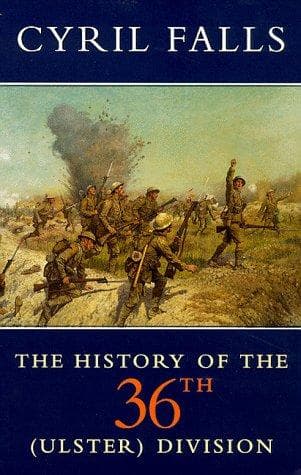
The History of the 36th (Ulster) DivisionFalls, Cyril
History
The History of the 36th (Ulster) Division
Falls, Cyril
Great Britain. Army. Division, 36th; World War, 1914-1918 -- Regimental histories -- Great Britain
The Brigade had, for the second time in a month, been cut to pieces.
The 12th Rifles alone had had upwards of fifteen hundred casualties
in that period. One often saw in our summaries of intelligence
reference to reports that such and such a German formation had had
particularly heavy losses, followed by a statement that it might
be considered negligible for some time to come. Few can have had
losses higher than those of the 108th Brigade, which had, as has been
recorded, practically disappeared by the end of March. Yet in ten
days' time this Brigade had entered another great battle, to prove
itself very far from negligible. The admiration one feels for its
achievements is mingled with surprise when one thinks of the youth
and lack of experience in its ranks. Well did it merit its share of
the commendation expressed in a telegram received from the G.O.C.
IX. Corps the day before it was finally relieved. The message ran as
follows:
"The C. in C. has just been at Corps H.Q. He would have liked to see
all ranks now fighting on the 9th Corps front, and to tell each one
of them of his personal appreciation of the magnificent fight they
have made and are making. He would like to shake hands with each
individual and thank him for what he has done. He has not time for
this, but has asked me to give everybody this message."
The 36th Division, when the 108th Brigade departed on its desperate
lone venture, was left with its front line east of Poelcappelle, and
its headquarters on the Canal Bank. On that very day, March the 10th,
the Army Commander decided to withdraw the II. Corps to its Battle
Zone, here practically the British front line of 1917. The right of
the 36th Division would now be just in front of Wieltje, so well
known of old. An outpost line was, however, to be maintained upon the
Steenebeek.
The retirement was absolutely essential, nor could it be delayed.
By April the 11th the Germans were approaching the Forest of
Nieppe. Passchendaele and Poelcappelle now protruded, an incredible
salient, that made the old Ypres Salient unremarkable by comparison.
Nevertheless, a few nights' respite was allowed, in order that the
enemy might be deprived of the booty, and of the shelter for future
operations, that had otherwise fallen to him. The heavy artillery
was to move back first, bringing back all the ammunition that
could possibly be carried, and tipping that which could not into
shell-holes. An extensive programme of demolitions was planned by the
C.R.E. Every dug-out or "pill-box" of importance was to be destroyed
by explosives at the last possible moment. Craters were to be blown
at important road-junctions. Light railways were to be, as far as
possible, torn up or otherwise demolished.
Public-domain text, read in full here on John Shaqi.
Reviews
Reviews
No reviews yet
Be the first to share your thoughts on this work.
Elsewhere in the archive
Join the Discussion
Join the discussion
Sign in to leave a comment or review.
Sign InorCreate an account