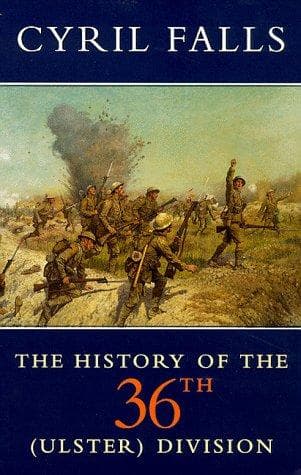
The History of the 36th (Ulster) DivisionFalls, Cyril
History
The History of the 36th (Ulster) Division
Falls, Cyril
Great Britain. Army. Division, 36th; World War, 1914-1918 -- Regimental histories -- Great Britain
On the following day a great attack was launched by the Germans from
south of Meteren to Voormezeele, upon the French D.A.N.[56] and
the Second British Army. Everywhere it was completely and bloodily
repulsed. To the enemy it was a terrible check. April the 29th, 1918,
deserves to rank as high as the following 8th of August[57] in the
history of the war. It marked the failure of the German northward
offensive. For failure that offensive was, as the Somme offensive was
not. The tenacity of troops on the flanks, such as the 55th Division
on the right and the 9th on the left, had confined and narrowed the
thrust. The curious formation of great hills, in almost straight line
across the Flanders plain; Kemmel, the Scherpenberg, Mont Rouge,
Mont Vidaigne, Mont Noir, Mont Kokereele, Mont des Cats, then, after
a gap, Cassel, proved an impassable barrier in later stages of the
battle. The first of the series alone fell. Upon the rest French
artillery was now massed, pouring death into the Germans below. A few
days earlier Ludendorff had, at a critical moment, struck again at
Amiens. That offensive, which might have changed the whole position,
had been pushed back before counter-attacks, and nipped in bud by the
brilliant recapture of Villers-Bretonneux by the Australian Corps.
The Germans were to make new offensives and gain much ground, notably
near Rheims, where they cut the main Eastern Railway, and came all
too close to Paris at Château-Thierry. But they were the blows of
desperation. Week by week drew nearer the great retribution.
The next six weeks passed quietly for the 36th Division. The chief
diversion was about a little dug-out near Juliet Farm, in the front
line, formerly a Signals testing-point for overhead wires. Here
there was constant bombing and raiding, largely to the disadvantage
of the German troops, who were not of first quality and were unable
to withstand our men in close fighting. During the month of May
fourteen prisoners were taken by the Division on seven separate
occasions. One night a German wagon with rations drove into our
outpost position in error and was captured, so indeterminate were the
opposing front lines. The 36th Divisional Artillery had returned and
taken over the defence of the front before the end of April. Early
in May it received, with all other British divisional artilleries in
France, a proportion of Indian personnel for its D.A.C., to replace
English drivers. These were thereupon sent back for training as
gunners.
Public-domain text, read in full here on John Shaqi.
Reviews
Reviews
No reviews yet
Be the first to share your thoughts on this work.
Elsewhere in the archive
Join the Discussion
Join the discussion
Sign in to leave a comment or review.
Sign InorCreate an account