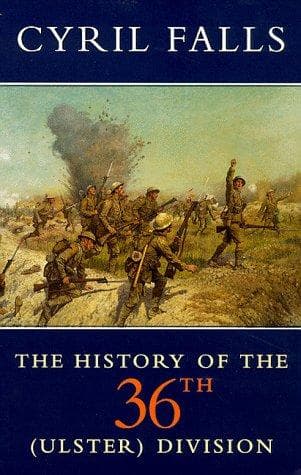
The History of the 36th (Ulster) DivisionFalls, Cyril
History
The History of the 36th (Ulster) Division
Falls, Cyril
Great Britain. Army. Division, 36th; World War, 1914-1918 -- Regimental histories -- Great Britain
On the following day the 36th Division actually lost a little ground
instead of gaining it. An attack carried out at dawn by the 1st and
9th Irish Fusiliers, under a light artillery barrage, insufficient to
keep down the very heavy machine-gun fire, was unsuccessful. A heavy
hostile counter-attack drove our troops back beyond their original
line. The 108th Brigade had now been fighting for four days, with no
shelter but that of old and dirty trenches, in persistent rain. The
men were in good spirits still, but fatigue was beginning to tell
upon them. It was decided that the 107th Brigade should relieve them
after dusk, to continue the attack upon the morrow. The 108th Brigade
had captured thirty-five prisoners and three machine-guns. Its
casualties, however, especially during the last two days, had been
very heavy, numbering upwards of four hundred. The 29th Division, on
the right, was again being relieved by the 31st.
The night of the relief was very unpleasant. The Germans, beginning
about ten o'clock, deluged all the low-lying valleys with mustard
and other gas shell. The new advance was to be supported by the fire
of two Machine-Gun Companies, instead of the one which had been in
action hitherto. Captain Walker describes how he rode out in the
darkness to find his sections, scattered among battalions of the
109th Brigade in reserve, and came into the cloud at Neuve Eglise,
forced to keep his eyes uncovered to find his way, but keeping the
nose-clip and mouth-piece of his respirator in position. When dawn
broke he discovered that the pool of gas lying in the basin in which
107th Brigade Headquarters were situated almost lipped the entrance
floor of the dug-out. Most fortunate it was that the dug-out was
half-way up the side of the basin. When, later, he walked down the
main road to Wulverghem, he found the occupants of the dug-outs which
bordered it "being sick by the score." A good many casualties were
caused during the relief, but for the most part the gas was not of
the most noxious sort, and many of those who had inhaled it were able
to take part in the action of September the 6th. It had the effect,
however, of delaying the relief. When dawn broke all the companies of
the 2nd Rifles were not in position; nor was it possible to move them
forward afterwards, owing to the forward slope on which that position
lay being in full view of the enemy.
The 36th Division Artillery was now prepared to put down a really
effective barrage, to advance at the rate of a hundred yards in three
minutes, then to form a protective curtain two hundred and fifty
yards in front of the objective, till an hour and a half after Zero.
This objective was the old British front line, from the Douve on the
right to the Wulverghem-Messines Road on the left.
Public-domain text, read in full here on John Shaqi.
Reviews
Reviews
No reviews yet
Be the first to share your thoughts on this work.
Elsewhere in the archive
Join the Discussion
Join the discussion
Sign in to leave a comment or review.
Sign InorCreate an account