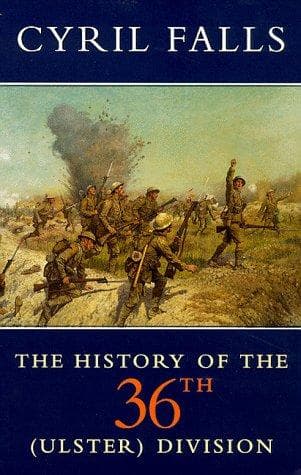
The History of the 36th (Ulster) DivisionFalls, Cyril
History
The History of the 36th (Ulster) Division
Falls, Cyril
Great Britain. Army. Division, 36th; World War, 1914-1918 -- Regimental histories -- Great Britain
At 4 p.m. the attack was launched. The companies of the 2nd Rifles
not already in position began to move up in little columns as
the bombardment opened, continuing this method of advance as the
barrage lifted. On the right, troops of the 31st Division attacked
simultaneously. Despite heavy German artillery fire the infantry went
forward with great spirit. After heavy fighting, all objectives,
except Gabion Farm on the right, were taken. Nineteen prisoners
were captured, and many Germans killed. How strongly the line was
held was shown by the capture of eight machine-guns, as well as a
trench mortar. The troops of the 31st Division also had reached their
objectives. Early on the morning of the 7th the advance was rounded
off by the capture of Gabion Farm, where a post was established.
The enemy was not yet resigned to the loss of the position. At
dawn on the 8th, after an intense bombardment, two groups advanced
to recapture the advanced posts. They were literally annihilated
by machine and Lewis-gun fire, a wounded survivor of each being
captured. That night the 30th Division took over the front to Gabion
Farm, while the 107th Brigade extended its right to Hyde Park Corner,
in "Plug Street Wood," becoming responsible for the defence of Hill
63.
Comparative stagnation ensued, broken only by two small attacks upon
the 15th Rifles, which had now taken over the line. The period was
marked by one distressing accident. General Thorpe, commanding the
107th Brigade, had gone up with General Brock on the night of the
13th to visit Hill 63 and the sentry-posts north of it. Moving along
"Winter Trench" he was suddenly fired at from point-blank range by
one of his own men and severely wounded in the arm, his elbow-bone
being shot away. It was a stroke of cruel ill-fortune, which
prevented General Thorpe from leading the Brigade to final victory.
He was able to return to the command of his regiment after the
war, but with an arm well-nigh useless for life, from which he has
since suffered incessant pain. Lieutenant-Colonel R. H. MacKenzie,
C.R.E. of the Division, took over command of the Brigade till the
appointment of his successor. That successor was General Brock, who,
after bringing the Divisional Artillery to France and commanding it
in the field for more than two and a half years, was to finish his
career with the 36th Division by leading an Infantry Brigade with
equal success. He was succeeded as C.R.A. by Brigadier-General C.
St. L. Hawkes, D.S.O. Another senior officer of the Division lost to
it a short time before was Lieutenant-Colonel J. E. Knott, D.S.O.,
commanding the 2nd Inniskillings, severely wounded by a shell which
killed the Intelligence Officer of the 109th Brigade, Lieutenant J.
J. Fox, and wounded the Brigade Major R.A., Major H. F. Grant Suttie,
D.S.O., M.C., by his side. Another calamity was the bombing of the
wagon lines of the Divisional Train near St. Jans Cappel. Here a
Public-domain text, read in full here on John Shaqi.
Reviews
Reviews
No reviews yet
Be the first to share your thoughts on this work.
Elsewhere in the archive
Join the Discussion
Join the discussion
Sign in to leave a comment or review.
Sign InorCreate an account