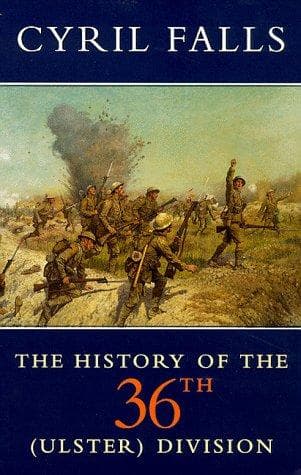
The History of the 36th (Ulster) DivisionFalls, Cyril
History
The History of the 36th (Ulster) Division
Falls, Cyril
Great Britain. Army. Division, 36th; World War, 1914-1918 -- Regimental histories -- Great Britain
Local counter-attacks did come against Twigg Farm, to be beaten off
with loss by the company of the 1st Irish Fusiliers which held it.
That night the 109th Brigade relieved the 108th.
The action of this day and of those following cannot be understood
without a brief survey of the general situation. The British advance
of the first two days, at its greatest point, from east of Ypres to
the Menin-Roulers Road, had been eight miles. The Germans had been
broken and thrown into confusion. But the very rapidity of the
Allied advance, over such roads as those which crossed the welter
of the old Ypres Salient, had created new difficulties. It was hard
enough, as has been related, to bring guns forward. But that was by
no means the main difficulty, even where the artillery was concerned.
Batteries in an advance go forward only. The limbers which feed them,
the lorries which feed the limbers from the train, must go forward
and backward. Therein lay the real trouble. The roads were choked.
The only tolerable among them, because, bad though they were, the
remains of the old _pavé_ held them together, were the Menin and
Zonnebeke Roads. Upon each was a solid mass of transport, which often
for hours at a time remained immobile. A few days after the events
already recorded, wagons of the 107th Brigade took thirty-six hours
to proceed from Potijze Château to Terhand. Captain Walker thus
describes the Zonnebeke Road on the night of the 30th of September:
"I had never previously realized the number and variety of vehicles
which move in support of three Divisions; indeed, I think this
road fed only the 9th and 36th Divisions.[61] There were limbers
by scores with rations; there were G.S. wagons with forage for the
battalion transports forward; there were R.E. wagons, mess-carts,
guns and ammunition; there were lorries stuck in shell-holes in the
road, and the cause of most of the trouble. On every odd bit of
ground bordering the road were French cavalrymen. The surface and
the language were equally bad, and there was mud everywhere. I had
to wind my way through these troubles for several miles. During my
journey there was practically no movement of the traffic. It had
taken 'C' Company's transport fourteen hours to do the six miles
from Ypres to the Ridge, and the Company bivouacked on the road for
a night. A Gotha flew down that road at midnight, dropping bombs
at regular intervals. I'm glad I missed that. There must have been
many casualties, for that road was a mass of animals and men. Why
only one Gotha was out that night beats me. 'D' Company, which
was supposed to be with the advancing infantry, was held up with
everybody else. Major Wood, the O.C., was panic-stricken, having the
General's orders to be in action at a stated time and place, and,
putting eight guns on pack mules, set off across the desolation.
I believe about four guns did eventually come into action, but a
couple of mules got into shell-holes from which they could not be
Public-domain text, read in full here on John Shaqi.
Reviews
Reviews
No reviews yet
Be the first to share your thoughts on this work.
Elsewhere in the archive
Join the Discussion
Join the discussion
Sign in to leave a comment or review.
Sign InorCreate an account