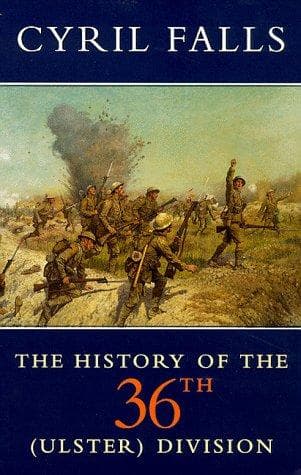
The History of the 36th (Ulster) DivisionFalls, Cyril
History
The History of the 36th (Ulster) Division
Falls, Cyril
Great Britain. Army. Division, 36th; World War, 1914-1918 -- Regimental histories -- Great Britain
extricated, and had to be despatched."
On the one hand, then, the Germans, now driven back to the fringe of
civilized and unbroken country, with roads and railways behind them,
were enabled to make some hasty attempts at reorganization; on the
other, the Allies, having overrun their supplies, were yet under the
necessity of keeping up steady pressure, to prevent the enemy from
improving and settling down upon those positions. Doubtless the enemy
had expected to be driven back and eventually to form up upon the
line of the Lys, but he had been driven back much more quickly than
he had anticipated, and was now anxious lest his troops should fall
back piecemeal upon the river, and its line be prematurely forced,
as the British line of the Somme had been forced in March. He was
therefore bringing up fresh troops, and, above all, artillery, with
the support of which a complete change had appeared in the fighting
quality of his infantry. The next fortnight was to be marked by a
constant see-saw, by desperate, if minor, stroke and counter-stroke.
Little more ground was to be won by the Allies till they had mastered
the difficulties behind them, pushed forward adequate artillery and
ammunition for a new "full-dress" attack to provide the initial
momentum for a great new advance.
On October the 2nd, the day after its relief of the 108th Brigade,
the 109th experienced the strength of the enemy's artillery and his
determination. At 5 p.m. a heavy barrage of artillery of all calibres
fell upon the front line, upon Dadizeele, and all approaches. Half
an hour later the German infantry advanced to the attack. The force
of the barrage had caused a withdrawal from some forward positions.
These the enemy penetrated, but was quickly driven out with the
bayonet. By night the line was completely restored.
It was during this attack that Captain G. J. Bruce, D.S.O., M.C.,
Brigade Major, 109th Brigade, making his way forward through the
barrage to ascertain the position, was killed. Captain Bruce was
one of the Division's original officers, and his total service with
it now amounted to over four years, except for a few months in
1917, when he had been Brigade Major of the 47th Infantry Brigade,
16th Division. His quickness and cleverness, and his wonderful eye
for country, which filled many a good professional soldier with
envy, made him a very fine example of the "civilian" staff officer.
His personal bravery was quite proverbial among all ranks of the
Division. He was one of those rare and fortunate men who do not seem
to require a mental effort, a summoning of resolution, to face great
danger. He walked into it as naturally and as unconcernedly as he
walked into his office. By all who knew him well George Bruce will
long be remembered as a sagacious soldier and a fine spirit.
Public-domain text, read in full here on John Shaqi.
Reviews
Reviews
No reviews yet
Be the first to share your thoughts on this work.
Elsewhere in the archive
Join the Discussion
Join the discussion
Sign in to leave a comment or review.
Sign InorCreate an account