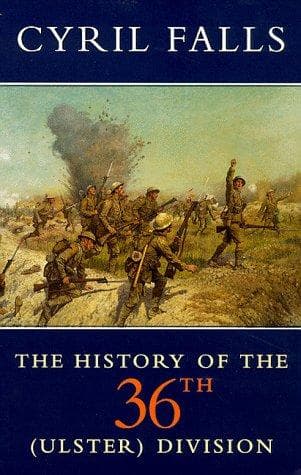
The History of the 36th (Ulster) DivisionFalls, Cyril
History
The History of the 36th (Ulster) Division
Falls, Cyril
Great Britain. Army. Division, 36th; World War, 1914-1918 -- Regimental histories -- Great Britain
General Nugent and his Staff arrived at Boulogne at midnight on the
3rd of October. Between the 5th and the 9th of the month the Division
concentrated in the area round Flesselles, where, some ten miles
north of Amiens, Divisional Headquarters were established. Here the
troops realized for the first time that France did not always mean
the firing-line. The sound of guns was, strangely enough, heard less
than it had been at Seaford, though the Vérey lights that could be
seen by night against the sky were evidence of the proximity of the
trenches. The countryside of the Somme was poor of soil, though
the industry of the inhabitants extracted good crops from it, and
curiously unlike that of the North of Ireland in its absence of
pasture. It was, however, pleasant enough, high and rolling, the
sites of the little villages in the uplands determined by the scanty
water supply, but traversed by numerous streams in the valleys, full
of beautiful panoramas wherever woodland interposed to break the
monotony of its contours. The villages were not uncomfortable so long
as troops could be widely spread. When, however, they were used as
"staging areas" and billeting was at all close, their poverty was
only too apparent.
Of this, some portions of the Division had early experience. On
October the 9th the 107th Brigade and the 1st/1st London Brigade
R.F.A. moved up for attachment to the 4th Division, and instruction
in trench warfare. The 4th Division at this time held a wide and
comparatively quiet front north of the River Ancre, which had been
taken over from the French during the previous summer. The general
method of instruction in vogue was the attachment of formations and
units to those next larger; that is, a battalion to an infantry
brigade, a company to a battalion, a battery to a brigade of
artillery. The troops in this preliminary experience of trench
warfare suffered less from the enemy than the elements. The weather
was bad, roads and trenches were wet; the billeting accommodation
_en route_ was scanty, and while in rest behind the line, consisted
almost entirely of war-worn tents without floor-boards. The men in
those first days scarce seemed to notice these things, so intense
was their eagerness and curiosity. The conventional and traditional
grumble of the British private soldier, a _sotto voce_ accompaniment
to the most generous efforts and the most unselfish devotion, was
forgotten here. One of the Brigadiers of the 4th Division said of
them:
"The men are extraordinarily quiet, and I thought at first somewhat
subdued, and put it down to the big marches they had had. But when I
came to talk to them I found they were like new schoolboys, taking
in everything, deadly keen, and only afraid of one thing--letting
down their unit in any way. I have never seen any men with such quiet
confidence in themselves, in spite of their efforts to hide it."
Public-domain text, read in full here on John Shaqi.
Reviews
Reviews
No reviews yet
Be the first to share your thoughts on this work.
Join the Discussion
Join the discussion
Sign in to leave a comment or review.
Sign InorCreate an account