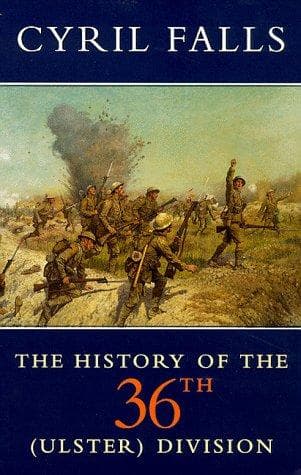
The History of the 36th (Ulster) DivisionFalls, Cyril
History
The History of the 36th (Ulster) Division
Falls, Cyril
Great Britain. Army. Division, 36th; World War, 1914-1918 -- Regimental histories -- Great Britain
The attachments lasted five days, the 107th Brigade being the only
one which was not divided between two divisions in the line. Its
attachment being complete, the 108th was sent up, two battalions to
the 4th Division and two to the 48th, further north. Then, towards
the end of the month, the 109th Brigade had its turn with the same
two Divisions. Meanwhile the R.E. Headquarters and the three Field
Companies had moved to Arquèves, to work on the new Third Army Line,
later to become important as the Amiens Defences. At this task they
were soon joined by the 16th Rifles (Pioneers), while they also
had as companions French Territorials. All worked hard and well,
though in the light of subsequent experience their trenches were
far too narrow, and their traverses too small by half. The troops
not under instruction in the line were kept hard at work training,
officers from the 4th Division having come to initiate them into the
mysteries of bombing--mysteries to which they took in kindly fashion.
One instructor declared that the national sport of the Ulsterman,
the throwing of kidney-stones in street riots, was an admirable
preparation for bombing. Another introduction was to gas helmets,
the horrible bags of those days without even mouth-pieces. Passing
through a gas-chamber in these bags was unpleasant, though accepted
as a necessity, but "doubling" and marching in them, as ordered by
some zealous instructors, was purgatory, and resulted in some of
the men being violently sick. On October the 21st the Division,
except for such infantry and artillery as were under instruction in
the line, moved slightly further west, toward Abbeville, to a more
comfortable and spacious area about Bernaville and Canaples, with
Headquarters at Domart-en-Ponthieu.
The Higher Command had decided that the 36th Division was not to
enter the line as a formation for the present. The Battle of Loos
was not long past, when troops fresh from England had been pushed
into the fight at its fiercest and after very long marches, with
disastrous results. It was determined that in future divisions should
be given a chance gradually to accustom themselves to the conditions.
Another decision which had been arrived at was that New Army and
Territorial Divisions should receive an admixture of thirty per cent.
of regular infantry by the transfer of brigades. Orders were received
for the transfer of one brigade to the 4th Division. The 107th, in
the command of which General W. M. Withycombe, C.M.G., had succeeded
General Couchman, was selected to go. The 12th Brigade of the 4th
Division was transferred to the 36th Division in exchange.
Public-domain text, read in full here on John Shaqi.
Reviews
Reviews
No reviews yet
Be the first to share your thoughts on this work.
Join the Discussion
Join the discussion
Sign in to leave a comment or review.
Sign InorCreate an account