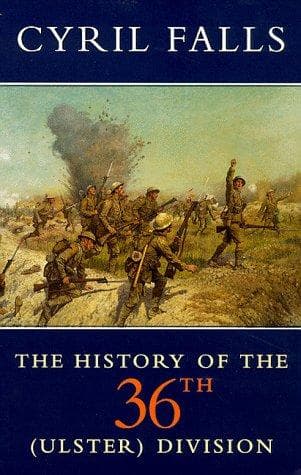
The History of the 36th (Ulster) DivisionFalls, Cyril
History
The History of the 36th (Ulster) Division
Falls, Cyril
Great Britain. Army. Division, 36th; World War, 1914-1918 -- Regimental histories -- Great Britain
The Brigade had during these three months established an excellent
reputation, both for work and for demeanour under fire. General
Nugent had suggested the reconstitution of the 36th Division on its
old basis on the grounds that, with three Brigades of Ulstermen, it
would be more homogeneous and of greater fighting value than as at
present constituted. This suggestion was favourably received. The
men had not been unhappy in the 4th Division, but feelings of local
patriotism were still strong in them, and they were most anxious to
return. It was announced that the reconstitution--the first of any
division so dismembered, and the only one which occurred for some
time--would take place simultaneously with the Division taking over
a portion of the front.
The 1st/1st London Artillery had departed, two howitzer batteries to
the East, and the remainder to the 38th Division in Flanders. The
original Artillery, henceforth the 36th Divisional Artillery, was
completing its training on the coast. With its exception the whole
Division now marched linewards, between the 2nd and 6th of February.
The 4th Division had meanwhile extended its right flank, and had
the 11th Brigade on the right of the 107th, its outer flank on the
River Ancre, just east of Hamel. As the new divisional boundaries
were to be the Ancre and the Mailly-Maillet--Serre Road, all that was
necessary to complete the relief and reconstitute the Division was
for the 108th Brigade to relieve the 11th. The 36th Division then
took over, at noon on February the 7th, its first line, with the
108th Brigade on the right, the 107th on the left, and the 109th in
reserve. Headquarters were at the large village, or small town, of
Acheux.
Of the next six weeks there is little of interest to report, save
a heavy bombardment of the left flank of the 107th Brigade and of
the 12th Brigade to the north of it. Shelling with 210, 105, and
77-mm. howitzers and field guns lasted for about half an hour, after
which the artillery lifted range to rear lines and communication
trenches. The 9th Rifles at once manned their battered trenches,
some men getting out beyond the wire and opening rapid fire. There
was no attack, though a party of the enemy succeeded in entering the
trenches of the 12th Brigade, to be quickly ejected. It was curious
that in this, its first bombardment, and a not inconsiderable one,
the Division did not suffer a casualty.
Public-domain text, read in full here on John Shaqi.
Reviews
Reviews
No reviews yet
Be the first to share your thoughts on this work.
Join the Discussion
Join the discussion
Sign in to leave a comment or review.
Sign InorCreate an account