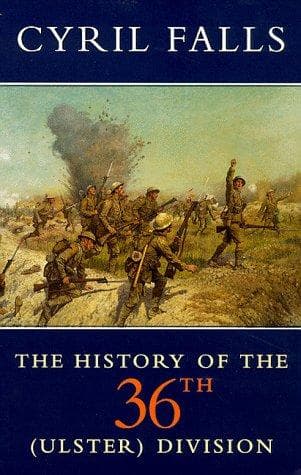
The History of the 36th (Ulster) DivisionFalls, Cyril
History
The History of the 36th (Ulster) Division
Falls, Cyril
Great Britain. Army. Division, 36th; World War, 1914-1918 -- Regimental histories -- Great Britain
The 107th Brigade had existed in a fashion less idyllic. On arrival
in the 4th Division area two of its battalions, the 8th and 15th
Rifles, were transferred to the 10th and 11th Brigades respectively,
while in exchange it received three battalions, the 1st Rifle
Brigade, 1st Royal Irish Fusiliers, and 2nd Monmouths. Three days
later it took over the left sector of the 4th Division front, astride
the Mailly-Maillet--Serre Road, the Brigade Headquarters being in
the former village. Here for upwards of two months it remained,
alternating with the 10th Brigade in six-day tours in the line. In
November the weather was indifferent; by December it became very
bad indeed. Men sank in the mud so that they had to be dug out by
their comrades with spades. The communication trenches were so deep
in water that they were for the most part impassable. Movement from
front to rear had to take place after dark, in the open. "Trench
feet," a disease then generally known as "frost-bite," though caused
by constant immersion of the feet in water far above freezing-point,
became prevalent. Rubber thigh boots, most precious of boons to men
in such sectors, were all too rare as yet, and had to be doled out
with parsimony. Battle casualties were light in this sector, but
the life in it was very far from pleasant. On New Year's Day the
Brigade, now returned to its original formation, exchanged it for
the right sector of the front held by 4th Division, south of the
Mailly-Maillet--Serre Road. Of this sector the chief peculiarity was
a tiny parallelogram of trenches jutting out from the British line
on the high ground east of Beaumont Hamel, known as the Redan. It
was a most unpleasant corner. In the first place, it was not more
than fifty yards from the German lines, and the mine-craters which
fringed its eastern edge, which were occupied at night by British
posts--a doubtful policy, as it appears to-day--were in constant
danger of surprise. During the 107th Brigade's tour one post was,
indeed, bombed by the enemy and a man taken out of it. In the second
place, the Redan was the scene of constant mining, and the bugbear of
battalions in reserve, which had to send up large working-parties to
carry sandbags filled with chalk for the miners. It was the one point
in our trenches which received fairly constant attention from German
gunners, and the average weekly casualties in this tiny lozenge were
probably higher than on the whole of the rest of the 4th Division's
front. One of the best pieces of work performed by the 107th Brigade
during this period was the construction, by the 8th Rifles, in one
night, of a trench a hundred yards in length and protected by a
double "apron" of wire, which denied to the enemy ground which would
have given him important observation. The digging and wiring were
carried out without arousing the least suspicion among the German
sentries.
Public-domain text, read in full here on John Shaqi.
Reviews
Reviews
No reviews yet
Be the first to share your thoughts on this work.
Join the Discussion
Join the discussion
Sign in to leave a comment or review.
Sign InorCreate an account