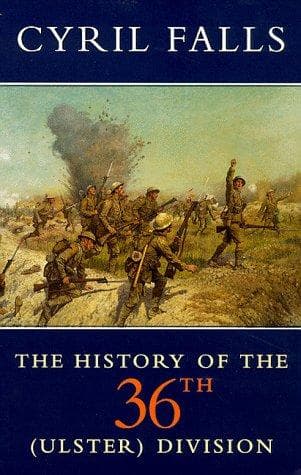
The History of the 36th (Ulster) DivisionFalls, Cyril
History
The History of the 36th (Ulster) Division
Falls, Cyril
Great Britain. Army. Division, 36th; World War, 1914-1918 -- Regimental histories -- Great Britain
If the 36th Division had yet something to learn by way of prevention
in these matters, it had little as regards cure. When rubber
boots--"gum-boots, thigh," in the parlance of the Ordnance--became
commoner, "trench feet" almost disappeared. The men laughed at the
special grease with which they were provided to rub their feet, but
they used it as they were ordered to do. Contrary to legend, but a
small proportion was really used for the frying of food. They laughed
also at the foot drill, each man rubbing the feet of his next number
once a day, but to a great extent they carried it out. Excellent as
these things were, the best remedy of all was found to be dry socks.
Drying them in the trenches was difficult, but it was easy to send up
dry ones by the ration parties at night, who took back the wet ones
with them and dried them during the following day.
As this History is intended not alone for men who fought in the war,
but also for their relatives and friends at home, a few remarks
on the routine of holding a line of trenches, commonplace to the
soldier as they may be, are perhaps permissible. Let us imagine a
division with two brigades in line, and one in reserve. Each of the
brigades in line would have two battalions in the trenches, relieved
at regular intervals, though never on the same night, by the other
two. These intervals were from four to eight days, according to the
weather and state of the trenches. The distance of the rest billets
from the front line, again, depended upon accommodation, the enemy's
command of the country from his observation posts, and the activity
of his artillery. They might be three or four miles back. At this
time the battalion which held the line at Hamel, on the right bank of
the Ancre, rested in Mesnil, little more than a mile from the German
lines. The battalion in the trenches had probably two companies in
the front line, one in support and one in reserve, and carried out
inter-battalion reliefs in the course of its tour. The front and
support lines were held by posts consisting of sections, about ten
or twelve men in these early days, half as many later on. These
posts furnished each a single sentry by day, and double sentries by
night. For half an hour before and half an hour after dawn, the hour
of surprise attacks, the troops would "stand to" in their trenches.
In winter months this was the hour of the rum-ration--very welcome
after a cold or wet night. Each company had one officer permanently
on duty in the trench, night and day. In the trenches these periods
were practically reversed. Night was the time when most of the work,
all the wiring, all the patrolling of "No Man's Land," was carried
out. Roughly speaking, the battalion in the line was responsible for
the work as far back as its headquarters, with the expert assistance
of a few sappers. Behind that worked the resting battalion--though
parties from this had frequently to assist the battalion in line
Public-domain text, read in full here on John Shaqi.
Reviews
Reviews
No reviews yet
Be the first to share your thoughts on this work.
Join the Discussion
Join the discussion
Sign in to leave a comment or review.
Sign InorCreate an account