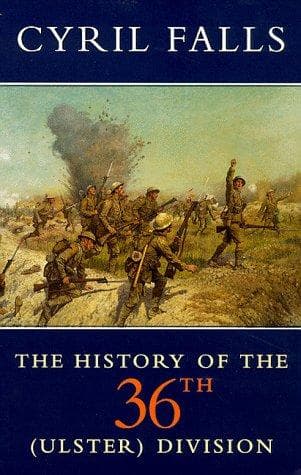
The History of the 36th (Ulster) DivisionFalls, Cyril
History
The History of the 36th (Ulster) Division
Falls, Cyril
Great Britain. Army. Division, 36th; World War, 1914-1918 -- Regimental histories -- Great Britain
also--under the direction of the R.E., of which one Field Company
was in general attached to each brigade. It was important that the
infantry should know the sappers, and look upon them as assistants
rather than task-masters. The Pioneer battalion had generally some
special task of importance allotted to it under the direction of the
C.R.E.
A Machine-Gun Company at this time formed part of each brigade. The
guns were distributed in depth in the trenches, but much further
forward than was the case later on, when the number of Lewis guns
with the infantry had been increased. Such subtleties as machine-gun
barrages, indirect fire, the linking of guns by telephone to
battalion headquarters, had as yet scarce been conceived. Machine
gunners and infantry had their ammunition and bombs in boxes let into
the parapet, these stores increasing in size from front to rear.
The artillery, in rear, was also distributed in depth. Covering two
brigades, as we have imagined, it would probably be divided into two
groups, the group commander living at or near the headquarters of
his infantry brigade. For this purpose the present formation, four
artillery brigades, of which one was a howitzer brigade, was clumsy
and extravagant. The howitzer brigade, for example, was invariably
split between the groups, and its commander "functioned" as an
administrator, but not as a combatant. This system was to be modified
later. The guns were in pits, hidden as well as possible among trees
or houses, or if in the open covered with "camouflage" to match the
surrounding fields. The dug-outs of their detachments were close
at hand, and, close at hand also, were pits containing from two
to four hundred rounds per gun. At dusk the guns were laid on the
"night-lines"; that is to say, each was set so as to fire upon a
certain zone, in accordance with a previously arranged plan. A sentry
in an observation post watched the line. Within a few seconds of a
telephone call or an "S.O.S." rocket going up, the guns could open
fire. An artillery liaison officer lived with each battalion in the
trenches.
Public-domain text, read in full here on John Shaqi.
Reviews
Reviews
No reviews yet
Be the first to share your thoughts on this work.
Join the Discussion
Join the discussion
Sign in to leave a comment or review.
Sign InorCreate an account