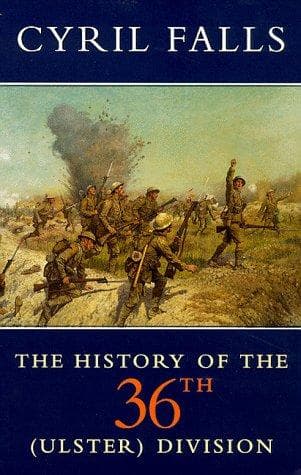
The History of the 36th (Ulster) DivisionFalls, Cyril
History
The History of the 36th (Ulster) Division
Falls, Cyril
Great Britain. Army. Division, 36th; World War, 1914-1918 -- Regimental histories -- Great Britain
all the lessons Ludendorff impressed upon his troops in the first
three months of 1918. But--and of this there can be no shadow of
doubt to-day--it laid the foundations of final victory.[20] The
German troops were never quite the same after it, while our young
levies, dreadful as were their sacrifices, were to arrive at a far
higher standard of military value.
The 36th Division was the left Division of the X. Corps, having on
its right the 32nd Division and on its left the 29th Division, not
long arrived from the East, which was in the VIII. Corps. The 49th
Division was in X. Corps Reserve. The 36th Division was to attack
astride the Ancre. On the left, or southern bank, its objective was
the fifth line of German trenches, known as the "D" line.[21] The
right flank boundary ran from the north-east corner of Thiepval
Wood to D 8. On the right bank the objective was a triangle of
trenches enclosed between the left boundary line and the Ancre,
beyond Beaucourt Station. The left boundary ran from the point of the
salient in our lines, known as the Mary Redan, to two houses half-way
between Beaucourt and its railway station, thence along the river
to the railway bridge. The ground rose sharply on either side from
the deep-cut bed of the Ancre, but while on the northern bank it was
cut by a gorge running down from the village of Beaumont-Hamel, at
right angles to the river, and parallel with the German trenches, on
the south it swelled up in a great convex curve, rising two hundred
and fifty feet in a thousand yards. The crest was crowned by a
parallelogram of trenches, extending from the German "B" line to the
"C" line, that will live long in history as the Schwaben Redoubt.
The trenches were defended by masses of wire. An artillery officer,
who made a careful reconnaissance with a good glass from "Brock's
Benefit," on the Mesnil Ridge, counted sixteen rows guarding the
front line just south of the river, and an average of five rows along
the second line. The dug-outs, most of them at least thirty feet deep
in the chalk, were to all intents and purposes shell-proof, and were
numerous enough to house the whole trench garrison. The enormous
activity behind our lines had taught the Germans long before that an
attack was brewing. They trusted to their fortifications and awaited
it with confidence.
Public-domain text, read in full here on John Shaqi.
Reviews
Reviews
No reviews yet
Be the first to share your thoughts on this work.
Join the Discussion
Join the discussion
Sign in to leave a comment or review.
Sign InorCreate an account