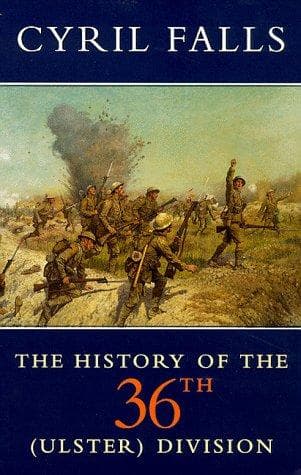
The History of the 36th (Ulster) DivisionFalls, Cyril
History
The History of the 36th (Ulster) Division
Falls, Cyril
Great Britain. Army. Division, 36th; World War, 1914-1918 -- Regimental histories -- Great Britain
The weather now took a turn for the worse, there being a sort of
cloud-burst on the 12th. Cross-country tracks were impassable for
infantry, and the carriage of ammunition to the new gun positions was
a very heavy task. The rain came at an unfortunate moment. Battalions
of the 109th Brigade were moving up to Aveluy Wood, south of Mesnil,
to complete the work of preparation. The 16th Rifles (Pioneers) were
there already. These troops had to endure the gravest discomfort
from the weather. Little canvas shelters were all their protection,
and for days together their clothes were not dry. Yet their work was
magnificent. When, almost at the last moment, a Regiment of French
Field Artillery joined the Division to assist in the attack, the
11th Inniskillings were ordered to help them in the construction of
gun-pits and shelters, with little enough time to do it. The men
threw themselves into the task with splendid enthusiasm. It seemed
that they worked the harder because their work was for strangers,
who would be left half-protected if they failed them. There was a
fine flavour of international courtesy in the manner of their toil,
for they gave of their free will energy that not the most skilful
of taskmasters could have wrung from them. General Nugent sent to
Colonel Brush, then in command of the Battalion, a letter of warm
congratulation upon their efforts.
In the battle that was about to begin, General Sir H. Rawlinson's
Fourth Army was taking the offensive along its whole front, with the
Sixth French Army of General Fayolle on its right. The Battle of the
Somme, the first in which our New Armies of volunteers were engaged
in great numbers, concerned the 36th Division but at its opening.
Its general aspects were, however, of the highest importance to
all the Allied troops. It differed broadly from such an action as
that of Loos. There an immediate strategic result was sought from a
small offensive. Here, while a break through was sought on the first
day, and would doubtless have been possible had the whole German
trench system been captured all along the front, thereafter the aims
became quite other. On the vast plateau of Picardy, an advance of
ten miles or thereabouts had small strategic importance. The nearest
first-class railway junction, Cambrai, was thirty miles away. The
new phase was the "limited offensive." The plan was to push forward
infantry behind artillery fire of overwhelming weight upon a broad
front, step by step, smashing down resistance. The plan was made
possible for us by the huge development of our munition factories.
It was the war of attrition. It was a mighty assault battle, wherein
England and France hurled man and gun and material upon German man
and gun and material. It had manifold and obvious blemishes. Its cost
was prodigious, particularly in its early stages, before certain
needful lessons had been learnt. It stereotyped attack and robbed
commanders of initiative, and was in this respect the text-book of
Public-domain text, read in full here on John Shaqi.
Reviews
Reviews
No reviews yet
Be the first to share your thoughts on this work.
Join the Discussion
Join the discussion
Sign in to leave a comment or review.
Sign InorCreate an account