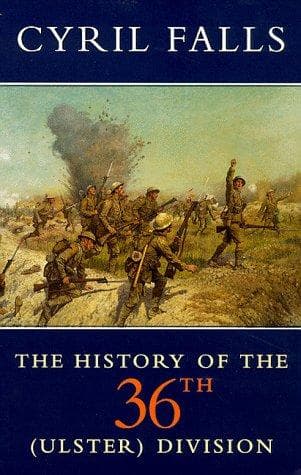
The History of the 36th (Ulster) DivisionFalls, Cyril
History
The History of the 36th (Ulster) Division
Falls, Cyril
Great Britain. Army. Division, 36th; World War, 1914-1918 -- Regimental histories -- Great Britain
For the first three months of 1917 the Division was without its
Pioneers, filched by the new "railway king," Sir Eric Geddes. The
Pioneers worked with their wonted vigour on 60 c.m. light railways
between Ouderdom, south of the Salient, and Kemmel, and between
Busseboom and Dickebusch, and also on broad-gauge work. In their
absence it was very difficult to continue the elaborate programmes of
construction. A temporary "Works Battalion," one company from each
Brigade, with a nucleus of one hundred trained Pioneers, who had been
retained, was formed to replace them. It was intensely unpopular
with the men, and cannot be said to have been a success. In February
practically all work of other natures ceased, so that men might be
put to that of wiring. The intense frost had converted the Belgian
inundations into solid ice! They were no obstacle to the enemy, who
for some weeks was suspected of the preparation of an offensive.
Certainly his artillery had become very aggressive, carrying out
heavy bombardments of our trenches and batteries, and shelling camps
in rear. The country was literally sown with wire, "Plug Street Wood"
being such a tangle that it has always been a mystery to those who
saw it how the Germans passed through it in 1918. The alarm died down
presently. It had never very serious foundation, but the frost in the
ground constituted a risk.
There was one advantage in holding the line in the same area
for a long period. It was possible to provide some comfort and
recreation for the troops. There were a football competition, boxing
competitions, a horse-show, many sports meetings. A large hut was
put up at Dranoutre for concerts and other entertainments. Over a
long period a 'bus ran daily from "Hyde Park Corner," just outside
Ploegsteert village, to Bailleul, which represented with its shops
and eating-houses comparative civilization. Many will recall with
regret its fine square and beautiful _Hôtel de Ville_, all smashed
to powder in 1918. Probably the worst hardships of the troops were
due to the intense cold of that winter. Life in the trenches was bad
enough, but there were many men who found it easier to sleep there
than in their rest camps. A bare, draughty wooden hut, a temperature
of fifteen degrees below zero, insufficient fuel; it does not
require much imagination to conjure up the misery implied by such
conditions.
Public-domain text, read in full here on John Shaqi.
Reviews
Reviews
No reviews yet
Be the first to share your thoughts on this work.
Elsewhere in the archive
Join the Discussion
Join the discussion
Sign in to leave a comment or review.
Sign InorCreate an account