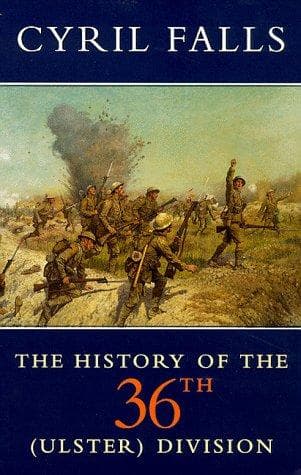
The History of the 36th (Ulster) DivisionFalls, Cyril
History
The History of the 36th (Ulster) Division
Falls, Cyril
Great Britain. Army. Division, 36th; World War, 1914-1918 -- Regimental histories -- Great Britain
With early spring came a great burst of activity. In the last days
of the old year the Division had been reorganized on a two-brigade
frontage, so that the troops of one Brigade might obtain some rest
and training. Now, in mid-March, it closed down to a small front,
from the Wulverghem-Wytschaete Road on the right, to a point opposite
Maedelstede Farm[30] on the left. This was held by one Brigade, the
second being well back about Flêtre, while the third trained in the
pleasant neighbourhood of Lumbres, west of St. Omer. No longer was
the Second Army Cinderella. Its area was packed with troops. Even the
private soldier, who saw the opening of the splendid new railhead
at Haagedoorne, outside Bailleul, with its maze of sidings, saw the
country covered with transport lines, saw the dumps grow full, saw
the digging of new communication trenches and the laying of light
railways, must have realized that something was toward. It is certain
at least that the enemy did. On the morning of March the 24th he
bombarded the lines of the 107th Brigade on the right flank and those
of the New Zealanders, its neighbours, for an hour and a half. Just
before dawn his men were seen to issue from their trenches. Caught
by our artillery barrage and the fire of machine and Lewis guns, the
party was swept away like chaff. He made other unsuccessful attempts
to raid the Division. That, however, represented but one aspect
of his alertness. The more serious was his persistent shelling of
billets and horse-lines, and his bombing of Bailleul. It was also
observed that he had large parties at work on his rear lines.
The Second Army was preparing the capture of the Messines-Wytschaete
Ridge.
The raiding activity of the Division was renewed in those last weeks
of preparation. On several occasions men slipped across in broad
daylight to the nose of the Spanbroek salient and threw bombs into
the German trenches. On May the 19th a raid was attempted from the
"Bull Ring," but beaten off by the enemy, who in turn sent over
parties in the early hours of the morning, which were beaten off
with loss. On May the 23rd the 14th Rifles raided the trenches on
the Kemmel-Wytschaete Road, taking a prisoner and confirming the
suspicion that the Germans had reinforced their line. On the 29th a
very big party of Germans, estimated at a hundred strong, made three
attempts to enter the "Bull Ring," but was kept out by the barrage
and the fire of the Lewis guns. These raids were without doubt
attempts to reach and destroy the mine-shafts in our front line.
Public-domain text, read in full here on John Shaqi.
Reviews
Reviews
No reviews yet
Be the first to share your thoughts on this work.
Elsewhere in the archive
Join the Discussion
Join the discussion
Sign in to leave a comment or review.
Sign InorCreate an account