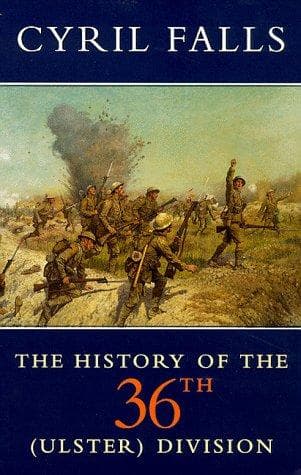
The History of the 36th (Ulster) DivisionFalls, Cyril
History
The History of the 36th (Ulster) Division
Falls, Cyril
Great Britain. Army. Division, 36th; World War, 1914-1918 -- Regimental histories -- Great Britain
Meanwhile there had come into the divisional area, and moved
quietly, battery by battery, into the positions already prepared,
the Divisional Artillery of the 32nd Division, with four Army
Artillery Brigades, making a total of 192 field guns and howitzers
on the front. All the positions for the incoming batteries had
been constructed by the 36th Divisional Artillery, and much of
their ammunition stacked in them ready for their use. Upon this
General Brock was most insistent. To him and to the hard work of his
subordinates the newcomers owed provision such as incoming batteries
all too rarely met with. A great mass of heavy artillery under the
orders of the IX. Corps had arrived also, and was bombarding the
slope of the Messines Ridge, doing great execution upon the concrete
shelters with which it was studded. The Germans could play at this
game also, and they had some tempting targets. All over the back
areas were horses piqueted in the open, troops in tents. Against
these the Germans did much damage with a railway gun, which, as it
could easily be moved, was safe from our fire. On the night of May
the 27th Divisional Headquarters, which had moved up to their new
Ulster Camp, west of Dranoutre, were bombarded by a 10 c.m. gun. A
direct hit was obtained on one of the huts, and several clerks were
wounded. The shelling continued for two hours, during which the
staff and personnel of the headquarters had to take to the fields.
That which would have been pure comedy--for such the spectacle of
a whole divisional headquarters running about in the dark must
undoubtedly appear to the troops--was turned to tragedy by the death
of Lieut.-Colonel W. A. de C. King, the C.R.E., who was killed on the
spot by one shell. On the following morning General Nugent moved,
with his advanced Headquarters Staff, to the command post that had
been prepared on the western slope of Kemmel Hill.
On the 31st of May the preliminary bombardment opened.
FOOTNOTES:
[25] In the month of July the Division received 193 officers and
2,182 other ranks. These reinforcements left it still, of course,
considerably below strength.
[26] Men who served do not need to be told, but perhaps civilians
may, that there was no parallel between these conditions and those of
early days, when there were often, literally, only a few rounds per
gun available. At this time the ammunition was there, in the gun-pits
and echelons behind, and could be used quite unsparingly at a sign of
danger. When, however, there was no danger, it had to be conserved.
[27] See Map II.
[28] The heavy and medium batteries were manned by artillery, the
Stokes mortars by infantry, personnel.
[29] Local names were frequently transformed by British troops,
followed by the map-makers. This was probably La Plus Douce. When
the Douve overflowed its banks the new name was certainly the more
suitable.
[30] See Map II.
CHAPTER V
MESSINES: JUNE 1917
Public-domain text, read in full here on John Shaqi.
Reviews
Reviews
No reviews yet
Be the first to share your thoughts on this work.
Elsewhere in the archive
Join the Discussion
Join the discussion
Sign in to leave a comment or review.
Sign InorCreate an account