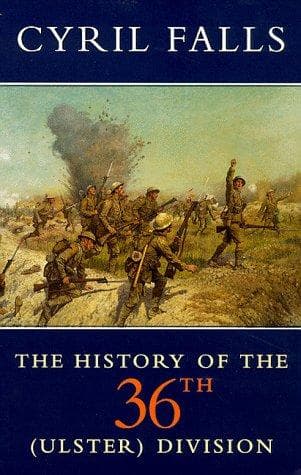
The History of the 36th (Ulster) DivisionFalls, Cyril
History
The History of the 36th (Ulster) Division
Falls, Cyril
Great Britain. Army. Division, 36th; World War, 1914-1918 -- Regimental histories -- Great Britain
Nothing was studied more carefully than the provision of food,
water, ammunition, and stores for the advancing troops. In front of
the huge divisional dumps at Lindenhoek cross-roads and "Daylight
Corner," on the Lindenhoek-Neuve Eglise Road, there were an advance
dump, a dump for each of the attacking brigades, six battalion
dumps, and many smaller in the trenches. An elaborate system of pack
transport was devised, two hundred extra pack-saddles with special
crates attached being issued. Two hundred and fifty "Yukon packs"--a
Canadian device which enabled a man trained in its use to carry a
very heavy load--were also issued. Arrangements were made to serve in
the trenches a hot meal at midnight prior to the assault. A special
ration of oranges, Oxo cubes, chewing gum, and lime juice was issued
to every man, and a tin of solidified alcohol for cooking to every
fourth man.
Means of communication, by visual signalling, pigeons, wireless,
the fullerphone, runners, and the rocket for S.O.S. calls, were
worked out in detail. For the fullerphone there were two lines of
buried cables, with cable-heads in our front line trenches. Forward
stations were selected in the enemy's line at Spanbroekmolen and
Peckham, to which armoured lines were to be laid across "No Man's
Land," from the cable-heads, by the brigade forward parties. As soon
as the final objective was reached, these forward stations were
to move to the crest of the ridge. Working independently of this
machinery, which was in the hands of the Signal Service, were the
brigade and battalion intelligence sections, the former of which were
to establish observation posts at Spanbroekmolen and Peckham, while
the latter moved up behind their battalions, selected observation
posts to follow their movements and cover their final position, and
sent out scouts to obtain touch with flanking battalions and bring
information as to their progress. For visual signalling a divisional
signal station was established on Kemmel Hill, which had a clear
line to the brigade forward stations, so that messages could be sent
either forward or back by the Lucas lamp.
The Second Army was to attack the Messines-Wytschaete Ridge, and the
ground east of it as far as the Oosttaverne line.[31] The IX. Corps
was allotted from the Wulverghem-Wytschaete Road to the Diependaal
Beek, a distance of six thousand four hundred yards along the front
line of the enemy's salient. It was to attack with three divisions
in line: from right to left the 36th (Ulster) Division, the 16th
(Irish) Division, and the 19th (Western) Division. These troops
were to advance to the Black Line, east of the Messines-Wytschaete
Road, after which the 11th Division, in Corps Reserve, was to pass
through to the final objective. A glance at the map will show how
the frontage of attack narrowed with every thousand yards of the
advance. On the right of the 36th Division was the 25th, in the II.
Anzac Corps.
Public-domain text, read in full here on John Shaqi.
Reviews
Reviews
No reviews yet
Be the first to share your thoughts on this work.
Elsewhere in the archive
Join the Discussion
Join the discussion
Sign in to leave a comment or review.
Sign InorCreate an account