The History of the 36th (Ulster) DivisionFalls, Cyril
History
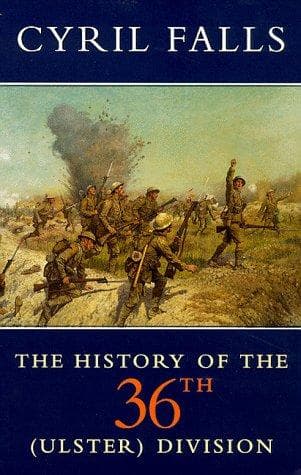
The History of the 36th (Ulster) Division
Falls, Cyril
Great Britain. Army. Division, 36th; World War, 1914-1918 -- Regimental histories -- Great Britain
The attack of the 36th Division, of which the final objective was
from Lumm Farm to a cutting on the Wytschaete-Oosttaverne Road east
of Staenyzer Cabaret, was to be made by two Brigades, the 107th on
the right and the 109th on the left, each having one battalion from
the 108th Brigade attached. Each Brigade was to attack with two
battalions in front, which advanced as far as the Blue Line, the
ground in rear of that objective being "mopped up" by the attached
battalion of the 108th Brigade. The remaining two battalions of each
Brigade were to pass through on the Blue Line for the advance to the
Black, providing their own "mopping-up" parties. The 107th Brigade
was to use the 8th Rifles on the right and the 9th on the left for
the attack on the Blue Line, with the 15th and 10th Rifles to pass
through to the Black Line. The 12th Rifles, from the 108th Brigade,
carried out the work of "mopping up" and consolidation in rear. The
109th Brigade was to use the 14th Rifles on the right and the 11th
Inniskillings on the left to take the Blue Line, and the 10th and 9th
Inniskillings to take the Black Line. The 11th Rifles were attached
for consolidation and "mopping up." The boundary line between the
36th and 16th Divisions ran, it will be noticed, along the main
street of Wytschaete, half the village being in the objective of each
Division.
The date of the attack was designated "Z" day, the five days of
preliminary bombardment being designated "U," "V," "W," "X," and
"Y." There had been considerable bombardment of the ridge before
"U" day, but from this day onwards it became more intense. Its
object was not the total destruction of the hostile trench system,
but the disorganization of the defence by the smashing of concrete
emplacements and shelters. It took nothing short of an 8-inch
howitzer to destroy the German concrete, while 12-inch and 15-inch
howitzers fired on Wytschaete. The cutting of wire was performed by
the 18-pounders, assisted in the case of the front line by trench
mortars. Further to disorganize the enemy, a programme of barraging
night and day his communications, and shelling his billets, was
carried out, while bursts of fire with lethal and lachrymatory gas
shell of various sorts took place throughout the period. Special
half-hour hurricane bombardments of Messines and Wytschaete, during
which every gun available, from largest to smallest, was in action,
were carried out. The barrage for the advance consisted of, firstly,
a creeping barrage of 18-pounder shrapnel, moving in advance of the
infantry, with average lifts of a hundred yards, at the rate of a
hundred yards in three minutes; and, secondly, a standing barrage
of 18-pounders, 4.5 inch howitzers, and medium and heavy howitzers,
established in succession on trenches and strong points. For the
creeping barrage there was one gun to twenty yards, firing at maximum
rate. One gun a section fired smoke shell, to screen the infantry.
Public-domain text, read in full here on John Shaqi.
Reviews
Reviews
No reviews yet
Be the first to share your thoughts on this work.
Elsewhere in the archive
Join the Discussion
Join the discussion
Sign in to leave a comment or review.
Sign InorCreate an account