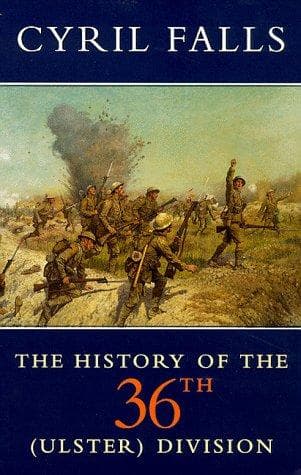
The History of the 36th (Ulster) DivisionFalls, Cyril
History
The History of the 36th (Ulster) Division
Falls, Cyril
Great Britain. Army. Division, 36th; World War, 1914-1918 -- Regimental histories -- Great Britain
The barrage was highly complicated, as, owing to the configuration of
the German salient and the varying rate of the advance, it lifted off
none of the objectives at the same moment all along the line.
Meticulous care was taken by Army Headquarters to ensure that the
preparation was as complete as human forethought could make it. Each
morning air photographs, showing the effect of the previous day's
bombardment, were circulated to Divisions in the line. Each Division
was required to state, day by day, what further special bombardment
it desired. From its observation post on Kemmel Hill the Staff of the
36th Division could see practically all the slope of the Messines
Ridge, from just above the dip of the Steenebeek valley to the crest.
Day by day it studied the ground during the bombardment. A trench or
concrete work which did not appear to have been sufficiently shelled
was noted, and request made that it should receive further attention
next day. Such requests were invariably met. Trenches and dug-outs
were shelled again and again, till Divisional Headquarters declared
itself satisfied. Many of the concrete structures were revealed
only when the bombardment of the trenches had blown away the earth
about them. They were then subjected to the fire of heavy howitzers
till destroyed. Finally, each Division was asked to state if it were
satisfied with the preparation. In the case of the 36th Division at
least, the answer was an enthusiastic affirmative.
The sympathy and understanding which existed between the Staff of the
Second Army and the man in the fighting line created a moral tone of
incalculable value to the Army's efficiency as a striking force.
The work of the preliminary bombardment threw a great strain upon the
personnel of the artillery, though such rest as possible was given
by carefully organized reliefs. The infantry was greatly impressed
with the results it could witness. In particular the liaison between
infantry and heavy gunners, hardly thought of before this action, was
of the closest, the artillery officers bringing battalion commanders
aeroplane photographs to show the results of the bombardment on their
front.
Public-domain text, read in full here on John Shaqi.
Reviews
Reviews
No reviews yet
Be the first to share your thoughts on this work.
Elsewhere in the archive
Join the Discussion
Join the discussion
Sign in to leave a comment or review.
Sign InorCreate an account