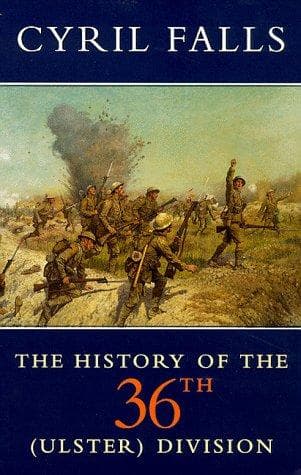
The History of the 36th (Ulster) DivisionFalls, Cyril
History
The History of the 36th (Ulster) Division
Falls, Cyril
Great Britain. Army. Division, 36th; World War, 1914-1918 -- Regimental histories -- Great Britain
Stokes mortars and machine-guns were assigned important _rôles_ in
the early part of the attack. The 3-inch mortars belonging to the
Division, less four a brigade, to be taken forward in the attack,
were to open a hurricane bombardment for three and a half minutes at
"Zero." A battery of 4-inch Stokes mortars, specially attached, was
to preface the assault with a bombardment of the Spanbroek salient,
with two lifts, using the highly demoralizing incendiary shell known
as "thermit." Six guns of the Machine-Gun Companies of the attacking
Brigades were to go forward with them; the rest of the guns of these
companies, with those of the 108th, the 32nd, two sections of the
33rd, and six guns of the 19th Motor Machine-Gun Battery,[32] a total
of sixty-six guns, were to be employed to provide a creeping barrage
beyond that of the artillery, a standing barrage on the main defences
of the ridge, and fire on strong points, woods, and ravines. One
section of Tanks[33] was allotted. They were not to catch up the
infantry till the Blue Line was reached, and in the advance to the
Black Line were to concentrate mainly upon Wytschaete.
All the successive lines, with the exception of the Green, were to
be consolidated, special strong points being established at such
positions as L'Enfer Farm, Skip Point, and Jump Point, in the Blue
Line; and Lumm Farm, Pick House, and Torreken Farm in the Black.
The infantry was to start the work of consolidation; then, when the
Black Line had been taken, the 121st and 150th Field Companies were
to move up to work upon the principal strong points. After dusk on
the evening of "Z" day, the 122nd Field Company was to move up and
construct a wire entanglement along the whole front of the Black
Line. Small opportunity, it will be seen, was left for successful
counter-attack if the assault reached its objectives.
Two contact aeroplanes were to be in the air at once throughout the
battle, calling at fixed hours, by the sounding of a Klaxon horn and
the firing of a Vérey light, for the signals by which the infantry
was to mark its progress. The latter consisted of green flares, lit
in bunches of three, and the turning of Watson fans, marked white on
one side and black on the other.
Public-domain text, read in full here on John Shaqi.
Reviews
Reviews
No reviews yet
Be the first to share your thoughts on this work.
Elsewhere in the archive
Join the Discussion
Join the discussion
Sign in to leave a comment or review.
Sign InorCreate an account