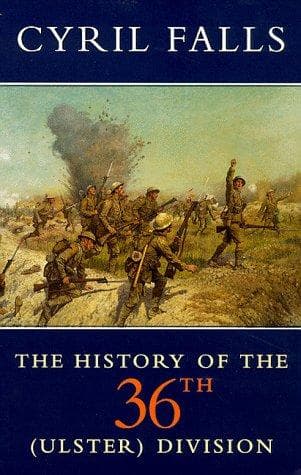
The History of the 36th (Ulster) DivisionFalls, Cyril
History
The History of the 36th (Ulster) Division
Falls, Cyril
Great Britain. Army. Division, 36th; World War, 1914-1918 -- Regimental histories -- Great Britain
A whole series of mines, the greatest ever used in war, was to be
fired at "Zero." Of these there were three on the 36th Division's
front: one at Kruisstraat Cabaret, one at Spanbroekmolen, and one
at Peckham. The second had been doubtful up to the last minute. The
passage to the charge had been cut some time before by a German
defensive "camouflet," and it had seemed as though the toil of a
year and of thousands of men had been wasted. The tunnellers of the
171st Company had laboured unceasingly to cut a new gallery. On the
eve of the action a scribbled note from the commanding officer to
Colonel Place, G.S.O.1. of the Division, announced that the work
was accomplished and that it was "almost certain" the mine would go
up. In case there might be failure with this or any other charge,
the assaulting infantry was instructed not to wait more than fifteen
seconds after the opening of the barrage before leaving its trenches.
For the evacuation of the wounded there was an Advanced Dressing
Station at Lindenhoek, close to the main road, skilfully prepared by
the 109th Field Ambulance. Wounded could be carried into the main
shelter by the entrance on the north side, from the trench tramway,
given what attention was necessary, and conveyed out by the exit on
the west side, where the motor ambulances of the Division arrived
by a specially constructed semi-circular road. This relieved the
main road at that point, and enabled the cars to sweep round without
turning. The cars bore the wounded to the Main Dressing Station
just east of Dranoutre, manned by the 108th Field Ambulance, while
"walking wounded" were sent by a specially-marked track to the Main
Dressing Station prepared for them and manned by the 110th Field
Ambulance a mile east of the village. From these Dressing Stations
the Motor Ambulance Park had the task of carrying the wounded to the
two Casualty Clearing Stations in Bailleul. Distances were shorter
and roads better than on the Somme; and, had the casualties been as
many as on that occasion, they would have been removed in less than
half the time and with far less discomfort to the wounded. As it most
happily chanced, the casualties were less than a fourth of those at
Thiepval.
So much for the preparations. Any of importance which have not been
mentioned will appear in the account of the actual battle.
Public-domain text, read in full here on John Shaqi.
Reviews
Reviews
No reviews yet
Be the first to share your thoughts on this work.
Elsewhere in the archive
Join the Discussion
Join the discussion
Sign in to leave a comment or review.
Sign InorCreate an account