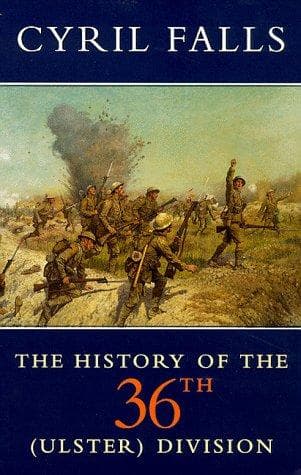
The History of the 36th (Ulster) DivisionFalls, Cyril
History
The History of the 36th (Ulster) Division
Falls, Cyril
Great Britain. Army. Division, 36th; World War, 1914-1918 -- Regimental histories -- Great Britain
The 108th Brigade held the line during the period of preliminary
bombardment, employing for the purpose the two battalions which it
was to retain during the battle as divisional reserve. It having
been decided to carry out some practice barrages in broad daylight,
to note the effect of the smoke shell, and see whether any guns were
shooting short, these seemed to offer good opportunity for big raids.
The first of these raids took place at 3 p.m. on June the 3rd. A
party of three officers and seventy other ranks of the 13th Rifles
entered the enemy's trenches at Peckham behind the barrage, and after
a short bombing fight captured nineteen prisoners of the 2nd German
Division. On the following afternoon at 2 p.m., a larger party of the
9th Irish Fusiliers followed the barrage into the Spanbroek salient,
returning with one officer and thirty men as prisoners--a remarkable
haul for a raid. Their casualties were two killed and six wounded.
It was a fine, sunny day, and, despite the haze of dust caused by
the shelling, the whole operation could be seen in detail from the
observation posts on Kemmel Hill. The barrage, though the rate of
fire was but a third of what it was to be on the great day, was very
impressive. It appeared a wall of curling smoke creeping slowly up
the ridge. The figures of the infantrymen following it could be seen
distinctly; there was the flash of bombs, and there were Germans
coming from their dug-outs holding up their arms. As the party
returned one man was seen to break away from it, walk back fifty
yards in most leisurely fashion, summon forth two Germans whom he had
evidently observed hiding in a hole, and bring them in at the point
of the bayonet.
The day of battle was at hand. Nothing could have been more
favourable than the elements to the British cause. The weather
was clear for observation, dry, and not unduly cold at night.[34]
The infantry which was to make the attack was bivouacked in tents
and shelters, the 107th Brigade south of Locre, the 109th S.W.
of Dranoutre, thus avoiding the shelling, particularly with gas,
wherewith the Germans visited all our hutted camps. After dusk on
June the 6th, "Y" day, these Brigades moved up to their positions
of assembly, which consisted partly of our front and support line
trenches, and partly of slit trenches specially dug. As on the
occasion of the assembly for the Somme Battle, cross-country tracks
had been prepared to avoid the congested roads. East of the Neuve
Eglise-Lindenhoek Road there were no less than four tracks available
for each brigade. It was reported that the assembly was complete,
without a hitch, by 2-30 a.m. on June the 7th.
Public-domain text, read in full here on John Shaqi.
Reviews
Reviews
No reviews yet
Be the first to share your thoughts on this work.
Elsewhere in the archive
Join the Discussion
Join the discussion
Sign in to leave a comment or review.
Sign InorCreate an account