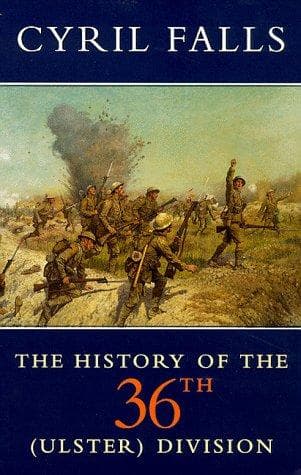
The History of the 36th (Ulster) DivisionFalls, Cyril
History
The History of the 36th (Ulster) Division
Falls, Cyril
Great Britain. Army. Division, 36th; World War, 1914-1918 -- Regimental histories -- Great Britain
The 16th Division lost one distinguished man in Major William
Redmond, M.P., who was brought in by stretcher-bearers of the 36th
Division, and conveyed to its Main Dressing Station. He had been
attached to Divisional Headquarters, but had insisted on rejoining
his regiment for the battle. His wound was light, but he was no
longer a young man, nor in a state of physical fitness to withstand
such a strain. He died some hours later.
The 36th Division had by no means finished with the
Messines-Wytschaete Ridge, even for this year; but before dealing
with its last days in the area, it may be not unprofitable to
speculate upon the causes of this triumphant success. If this
account has achieved its object, the majority of them will stand
out clearly enough. In the conferences after the battle, and in
reply to _questionnaires_ issued by the commanders, there were very
few criticisms made. Zero, as has been stated, was considered to
have been too early, though by not more than a few minutes at most.
All the infantry was enthusiastic about the manner in which the
artillery had been handled, and about the effect of the barrage.
Some battalions considered that it had been set to move rather too
fast, but the general opinion was that the infantry had been able to
keep up with it comfortably enough, and that the pace was a factor
in the success. The mines, it was agreed, had been decisive in the
capture of the front-line system, and had exercised a great moral
effect much farther back. The tanks had been a success. They were
useful in incidents such as that which has been described, and they
probably saved the infantry some casualties on the top of the ridge.
Broadly speaking, however, they did not appear to have exercised any
great effect upon the course of the battle. Brigadiers and battalion
commanders were unanimous in praise of the smoothness with which the
machinery worked from behind. The services of supply--the Divisional
Train, Supply Column, and Divisional Ammunition Column--were at their
best, and their standard of excellence was high. The Ordnance had
responded to every demand made upon it for the multifarious material
used in the offensive.
With regard to the infantry itself, the most interesting feature of
the Battle of Messines was the triumph of the platoon. Each platoon
had now a Lewis-gun section and a section of rifle grenadiers. It
was converted thereby into a little self-sufficing force, an army in
miniature, with every weapon necessary for the carrying out of the
minor operations likely to confront it in such an assault. Some of
the platoon leaders displayed in this battle a high order of tactical
skill.
But let us glance also at the affair from the other side, where a
German Army Commander, the famous Sixt von Armin, was seated at his
map-table. What were the problems that confronted him, and how did he
face them?
Public-domain text, read in full here on John Shaqi.
Reviews
Reviews
No reviews yet
Be the first to share your thoughts on this work.
Elsewhere in the archive
Join the Discussion
Join the discussion
Sign in to leave a comment or review.
Sign InorCreate an account